
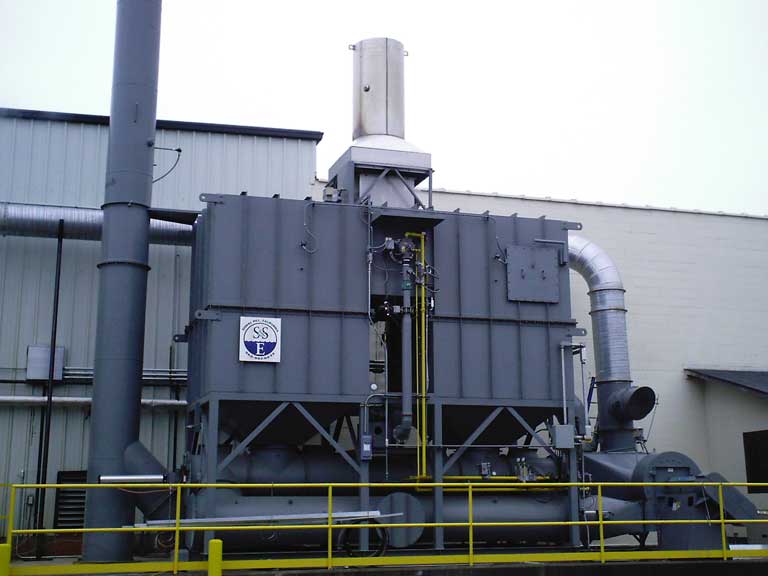
RTO Systems for Battery Recycling
Custom VOC abatement for compatible battery-recycling exhaust, with integrated capture, pretreatment, heat recovery and lifecycle support.
- Electrolyte and solvent vapors
- Process-specific exhaust review
- Acid-gas and dust coordination
- Expansion-ready engineering
When Does an RTO Fit a Battery Recycling Plant?
An RTO for battery recycling uses controlled thermal oxidation to treat compatible organic vapors in collected process exhaust. Potential applications include electrolyte-solvent removal, drying and selected thermal-pretreatment vents. Regenerative ceramic media recover outgoing heat and preheat incoming gas, reducing auxiliary heating demand.
Not every recycling line needs an RTO. Feedstock chemistry, the recycling route, gas composition and operating conditions determine the appropriate control train. An RTO system is not a substitute for metal recovery, particulate collection, acid-gas treatment or battery fire protection.
EV Battery Recycling: Plan for Changing Feedstock
EV battery recycling plants can receive manufacturing scrap, rejected cells, modules and end-of-life vehicle packs. These materials do not create one uniform exhaust stream. Electrolyte content, residual liquids, state of charge and processing methods can vary between incoming batches.
The IEA’s Global EV Outlook 2026 identifies a substantial lag between battery deployment and end-of-life recycling volumes. Manufacturing scrap is important today; retiring EV and storage batteries create a longer-term opportunity as the installed fleet ages. Feedstock supply and timing remain uncertain.
Plan around the contracted feedstock and operating envelope available now, with a documented expansion strategy. Changes between LFP, NMC, NCA or mixed incoming material should trigger a chemistry and emissions review, not an assumption that the original control design still fits.
For adjacent applications, explore battery manufacturing emissions control and the broader recycling industry RTO resource.
Battery Recycling Processes and Exhaust Questions
Electrolyte Removal and Drying
Volatile electrolyte solvents can enter collected gas during removal or drying. Evaluate recovery or condensation first where useful, then assess compatible residual VOC exhaust for oxidation.
Shredding and Mechanical Separation
Mechanical processing can release vapors and fine material. The enclosure, extraction and particulate-control strategy must be evaluated with the recycling equipment; an RTO does not collect black-mass dust.
Thermal Pretreatment and Binder Removal
Thermal steps may produce changing organic gases and fluorine-containing constituents. Gas testing, corrosion review and a defined treatment sequence are essential before selecting an oxidizer.
Hydrometallurgy and Materials Recovery
Leaching and recovery have different vent and liquid-treatment needs. Assess each source separately; the presence of a hydrometallurgical process does not itself establish a need for an RTO.
These are evaluation points, not a prescribed flowsheet. The process supplier and emissions-control engineering team must establish the actual sources, compatible equipment and operating limits.
VOC Treatment Is Different From Dust and Acid-Gas Control
Where Thermal Oxidation May Help
- Compatible organic solvent vapors in collected process exhaust.
- Residual VOCs after an appropriate solvent-recovery or conditioning step.
- Selected organic compounds from drying or thermal processing, after stream review.
What Needs Separate Evaluation
- Black-mass dust and entrained metals: evaluate particulate collection.
- Hydrogen fluoride and other acid gases: assess compatible gas-treatment equipment.
- Wastewater, battery discharge, thermal-runaway protection and emergency venting: distinct process and safety systems.
Engineer the Complete Exhaust-Control System
Source capture and collection-system design come first. Coordinate enclosures, ductwork, process pressure and fan duty with the recycling equipment. Capture efficiency and VOC destruction performance are separate parts of overall emissions control.
Dust, droplets, condensables and corrosive compounds can affect fans, valves and ceramic media. The engineering review should establish conditioning, cleaning access and the position of each treatment stage rather than assume one standard sequence.
Inert or oxygen-lean gas, high-heating-value streams and combustible peaks need a specific combustion and process-safety assessment. An RTO is not automatically suitable for raw pyrolysis gas. Do not change an inert process or introduce dilution air without the process supplier’s engineered safeguards.
Ship & Shore’s air-pollution abatement engineering connects equipment selection with process integration. Where the stream does not suit an RTO, evaluate a different thermal oxidation configuration or another appropriate control approach.
Heat Recovery, Utilities and Future Expansion
Regenerative heat recovery is part of the RTO cycle. Actual fuel demand depends on airflow, VOC heat content, moisture, operating hours and heat loss. Neither a recycling label nor an EV application guarantees autothermal operation or a fixed operating cost.
Secondary heat recovery may be considered when a useful plant heat demand matches the available energy. Evaluate electrical capacity, fuel supply, tariffs and reliability before comparing conventional, electric RTO or hybrid gas/electric arrangements.
For a phased EV battery recycling plant, document current and future exhaust sources, peak flow, operating shifts and tie-in provisions. Expansion changes may require new equipment sizing, controls and permitting review.

Information for a Battery Recycling RTO Proposal
Share the information available now. A preliminary engineering review can identify the measurements and process details still needed.
Feedstock and Process
- Battery chemistries, cell formats, scrap versus end-of-life packs and expected throughput.
- Process descriptions, equipment flowsheets and planned operating modes.
- Electrolyte, solvent and binder information, with available safety data sheets.
- Measured VOC composition, mass loading, moisture, dust and potentially corrosive constituents.
- Normal production, cleaning, startup, shutdown and upset scenarios.
Exhaust and Facility
- Minimum, normal and peak airflow with its reference conditions, temperature, pressure and oxygen content.
- Existing capture, solvent recovery, filtration and gas-treatment equipment.
- Utilities, site layout, maintenance access and installation windows.
- Permit limits, monitoring requirements and available emissions-test results.
- Phased capacity additions and the plant heat demand that could use recovered energy.
Air-permit requirements are facility- and jurisdiction-specific. Confirm the applicable obligations with the permitting authority and qualified project advisers; equipment selection alone does not establish compliance.
Relevant Ship & Shore Project Experience
Recycling: Variable VOC Exhaust
SSE’s published metal-recycling case study describes a custom RTO designed around changing VOC loading and production growth. It offers useful context for integrated system planning, but it is not an EV battery recycling installation.
Battery Manufacturing: Technology Selection
SSE’s automotive battery-cell manufacturing case study describes a direct-fired thermal oxidizer, illustrating why the process stream drives technology selection. Battery-cell manufacturing and battery recycling are different applications.
From its Signal Hill, California base, Ship & Shore brings system design, fabrication, equipment installation and aftermarket support together for industrial emissions-control projects.
Battery Recycling RTO FAQs
Does every EV battery recycling plant need an RTO?
No. The appropriate controls depend on the recycling process, exhaust composition, operating conditions and applicable requirements. An RTO may suit compatible organic vapors, while other sources require recovery, particulate collection, gas scrubbing or a different treatment approach.
Which battery recycling exhaust streams may be candidates for RTO treatment?
Potential candidates include compatible VOC-bearing exhaust from electrolyte-solvent removal, drying and selected thermal pretreatment operations. Gas characterization, pretreatment needs and operating limits must be established before an RTO is selected.
Can an RTO remove hydrogen fluoride or metal-bearing dust?
An RTO is not a substitute for acid-gas treatment or particulate collection. Fluorine-containing compounds, hydrogen fluoride, entrained metals and black-mass dust require specific review and potentially separate treatment equipment.
Is an RTO automatically suitable for pyrolysis gas?
No. Oxygen content, fuel value, combustible peaks, corrosive constituents and process-safety requirements can make a different combustion arrangement necessary. The process supplier and qualified engineering team must evaluate the gas before any connection or operating change.
How does an RTO support the energy strategy of a recycling plant?
Ceramic media recover heat from treated exhaust and preheat incoming gas, reducing auxiliary heating demand. Actual energy use depends on process conditions. Additional heat recovery requires a useful plant demand and a project-specific engineering assessment.
Can the system accommodate future EV battery recycling capacity?
Future sources, operating ranges and equipment additions can be considered during initial engineering. Expansion is not automatic: added flow or changed chemistry can require revised sizing, controls, treatment stages and permitting review.
Does a battery-recycling RTO provide fire or thermal-runaway protection?
An RTO is an emissions-control device, not a replacement for battery discharge, fire protection, thermal-runaway safeguards or emergency venting. Those systems require their own process and safety design.
Technical Background and Sources
- U.S. EPA: Lithium-Ion Battery Recycling : recycling routes, manufacturing scrap and material recovery.
- Argonne ReCell: Electrolyte Components Removal and Recovery : electrolyte characteristics and removal approaches.
- UK Environment Agency: Waste-Battery Treatment Technical Guidance : chemistry-specific emissions and treatment considerations. This is technical background, not a statement of U.S. permit requirements.
- U.S. EPA: Thermal Oxidizer Monitoring : oxidation, heat recovery and performance monitoring.
- IEA: Global EV Outlook 2026, Electric Vehicle Batteries : recycling feedstock and the timing of end-of-life supply.
Plan Your Battery Recycling Emissions-Control System
Tell Ship & Shore about your feedstock, recycling process, exhaust conditions and expansion plans. Our engineering team can help evaluate the right next step for a new facility, added line or equipment replacement.
Explore all industries served and the RTO glossary.