#TechTalk: Solar Cell Production: Controlling Emissions from Cleaning, Coating & Chemical Processing
November 11, 2026 4:51 pm#TechTalk: Solar Cell Production: Controlling Emissions from Cleaning, Coating & Chemical Processing
Solar energy supports the global transition toward renewable electricity, but manufacturing photovoltaic (PV) panels also involves industrial processes that can generate air emissions.
Where Do Emissions Originate?
Conventional crystalline-silicon PV manufacturing involves four main stages:
- Polysilicon Production: Silicon derived from quartz undergoes chemical purification to achieve the required purity.
- Wafer Manufacturing: Purified silicon is melted into crystalline ingots and sliced into thin wafers.
- Cell Fabrication: Wafers undergo chemical texturing, doping, surface treatment, and metallization.
- Module Assembly: Solar cells are interconnected and encapsulated between protective glass and polymer layers.
Additional cleaning, coating, printing, and finishing operations may also be required. Depending on the production line, certain operations use organic solvents that can generate Volatile Organic Compound (VOC) emissions.
Why Does VOC Control Matter?
VOCs are organic compounds that evaporate into the atmosphere. In sunlight, certain VOCs react with nitrogen oxides (NOx), contributing to ground-level ozone and smog.
Some VOCs are also classified as Hazardous Air Pollutants (HAPs) under the U.S. Clean Air Act due to their potential health effects.
As production expands, manufacturers must evaluate process emissions, facility-wide pollutant levels, and applicable air permitting requirements.
The RTO Solution
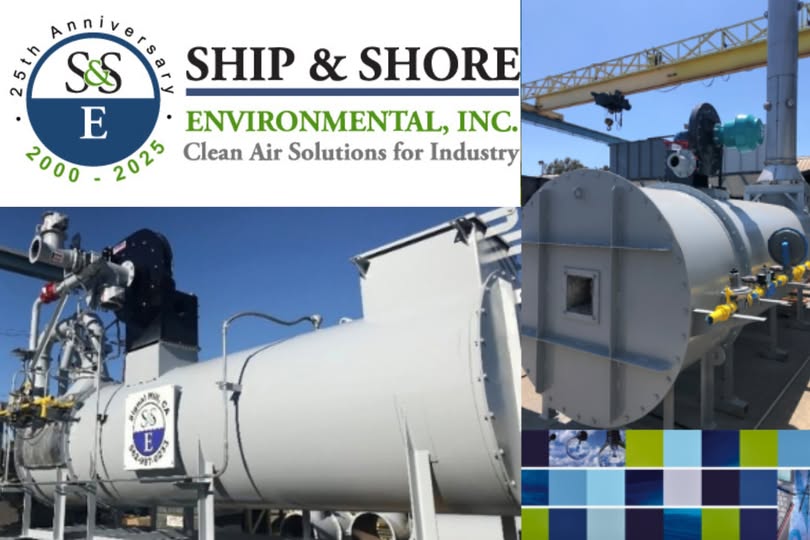
For suitable exhaust streams, a Regenerative Thermal Oxidizer (RTO) uses high-temperature oxidation to destroy targeted organic pollutants.
Its ceramic heat-transfer media recover energy from treated exhaust and use it to preheat incoming process air.
Depending on system design and operating conditions, RTOs can offer:
- Up to 99% VOC Destruction Efficiency
- Up to 97% Thermal Heat Recovery, reducing supplemental fuel requirements
- Energy-Efficient Operation through regenerative heat exchange
- Custom-Engineered Configurations for varying airflow rates and pollutant concentrations
S&SE: Supporting Cleaner Solar Manufacturing
Ship & Shore Environmental (S&SE) engineers and manufactures custom air pollution control systems for industrial applications, including solar PV manufacturing.
With experience delivering RTO systems for solar manufacturers in the United States, S&SE provides customized engineering solutions to address process emissions and air quality requirements.
From process evaluation and system design to manufacturing, installation, and commissioning, we help manufacturers integrate effective emissions control into their operations.
Cleaner energy starts with responsible manufacturing.
Ship & Shore Environmental | Protecting America’s Air Since 2000.
#SolarManufacturing #VOCControl #RTO #AirPollutionControl #EnvironmentalEngineering
Categorised in: Air pollution, Green Energy, Industry news, News, News, RTO, Ship & Shore, Technology, TechTalk, VOC Abatement