
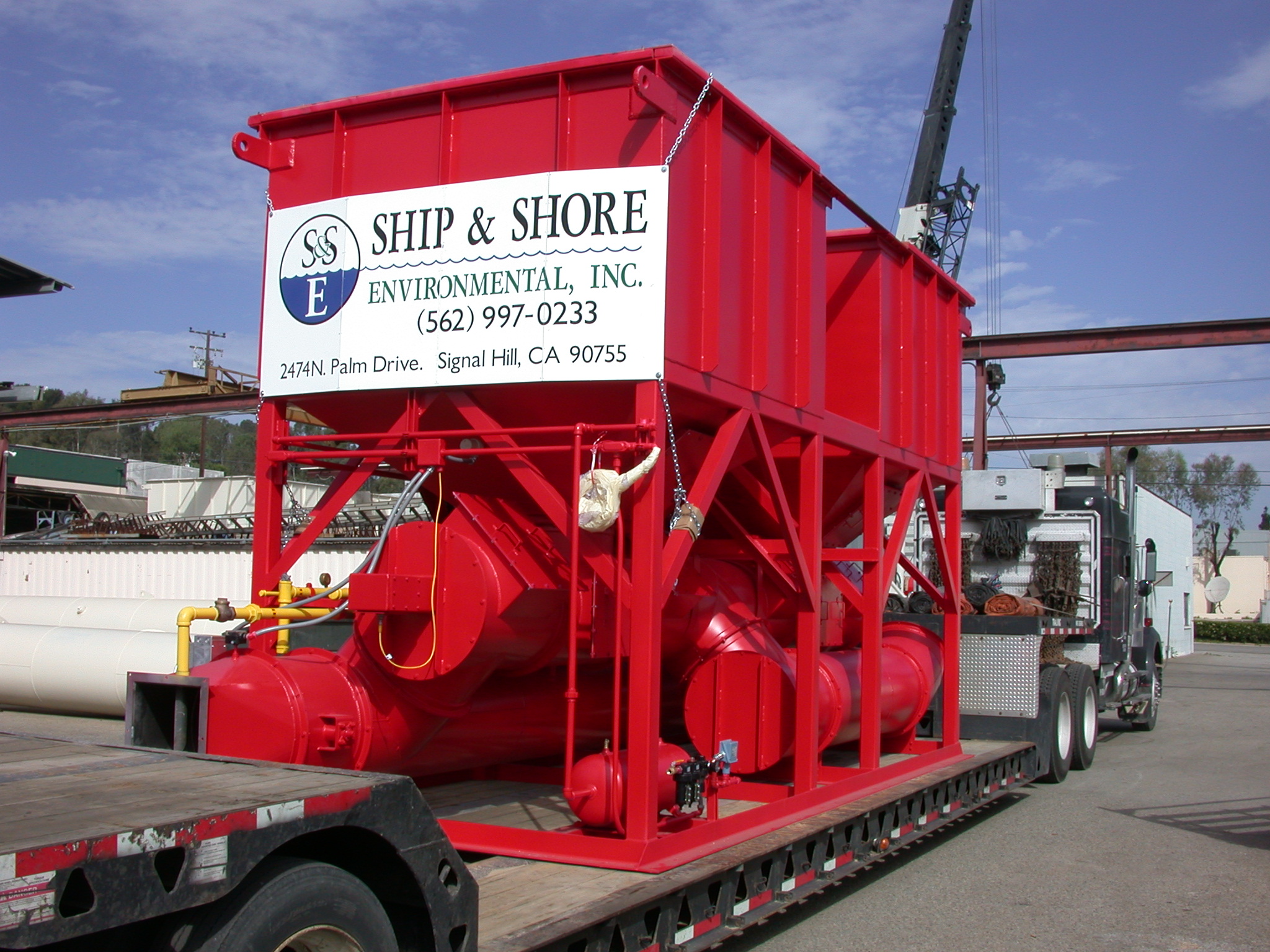
Hybrid RTO Systems
Ship & Shore Environmental engineers custom regenerative thermal oxidizers that combine electric heating with gas-fired support in one coordinated platform. A hybrid RTO can provide a practical bridge between conventional fuel-fired operation and facility electrification while preserving regenerative heat recovery, operating flexibility, and application-specific emissions control.
- Electric and fuel-fired auxiliary heat
- Regenerative ceramic heat recovery
- Application-specific operating modes
- Integrated controls and lifecycle support
What Is a Hybrid Regenerative Thermal Oxidizer?
A hybrid regenerative thermal oxidizer is an industrial air pollution control system that can use both electric heating and a fuel-fired burner to supply auxiliary heat for VOC and volatile HAP oxidation. Regenerative ceramic media stores energy from treated exhaust and transfers it to the incoming process stream, reducing the heat that either auxiliary source must provide.
The core process remains a regenerative thermal oxidizer. The hybrid architecture adds energy-source flexibility, controls, interlocks, and utility coordination. Ship & Shore defines the heating arrangement and permitted modes from process chemistry, airflow, VOC loading, electrical infrastructure, fuel supply, permit conditions, and lifecycle economics.
Building Blocks of a Gas and Electric RTO
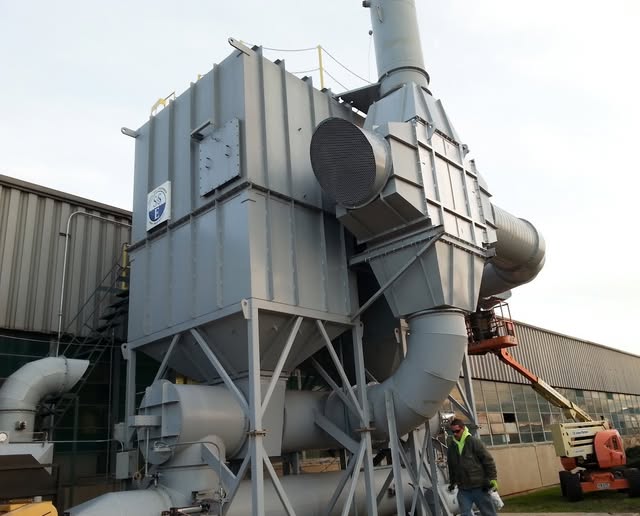
These images illustrate Ship & Shore RTO and controls capabilities relevant to a hybrid platform. The final heater arrangement, burner, electrical distribution, controls, and materials are engineered for the facility rather than inferred from a representative photograph.

Why Consider a Hybrid RTO?
A dual-energy system can create options that an all-electric or single-fuel design does not provide. The value of each option must be confirmed against actual utilities, emissions, reliability, and lifecycle requirements.
Staged electrification
Begin reducing auxiliary fuel use while retaining engineered gas support during infrastructure or operating transitions.
Utility flexibility
Use approved operating modes to respond to electrical capacity, demand limits, gas availability, and site energy strategy.
Resilience planning
A second heat source may support continuity when one utility is constrained, provided the system is designed and permitted for transfer.
Burner-use reduction
Electric operating periods can reduce or eliminate the auxiliary gas burner’s direct contribution while the burner is off.
Demand management
Gas assistance may help limit electrical peak demand when heater load, service capacity, or tariff conditions require it.
Future-ready controls
A documented control architecture can support evolving production, utility contracts, sustainability plans, and operating priorities.
Regenerative efficiency
Ceramic media recovers energy from treated exhaust before either auxiliary heat source is called.
Lifecycle selection
Ship & Shore compares capital, utilities, maintenance, compliance, reliability, and operating schedules as one decision.
Custom engineering
Heater capacity, burner duty, chamber, media, controls, and auxiliaries are sized from facility-specific process data.
How Does a Hybrid RTO Work?
The regenerative cycle recovers heat first. Electric elements and the fuel-fired system then provide the auxiliary energy required by the selected operating mode and current process load.
- 1Collect exhaustProcess capture routes applicable VOC-laden air to the RTO.
- 2Verify conditionsControls prove airflow, temperature, valve position, and safety permissives.
- 3Recover heatHot ceramic media preheats the incoming stream.
- 4Select auxiliary heatControls call for electric heat, gas support, or an approved combination.
- 5Oxidize pollutantsTime, temperature, turbulence, and oxygen drive treatment.
- 6Store outgoing heatTreated gas transfers energy into the next media bed.
- 7Reverse and optimizeValves alternate beds while controls manage heat-source demand.
VOC heat can reduce both auxiliary energy inputs
When VOC loading supplies sufficient heat, electric and gas demand may fall substantially. Under certain engineered conditions, autothermal operation may temporarily eliminate auxiliary heat while fans, valves, controls, instrumentation, and safety systems continue to use power.
Hybrid RTO Operating Strategies
The control narrative should define exactly when each energy source is available, how a transfer occurs, and what the system does when process or utility conditions move outside the approved envelope.
Electric-first with gas backup
Electric elements provide normal auxiliary heat while the fuel-fired system remains available for approved backup, peak, or recovery conditions.
Gas startup, electric steady state
The burner supplies startup duty, followed by electric modulation after the chamber and media reach the engineered transition conditions.
Electric trim with gas assist
Electric heat handles routine modulation while gas assistance supports higher-duty periods or an electrical demand ceiling.
Gas-first with electric backup
Fuel-fired operation remains primary while electric capacity provides an approved alternative or supports a future electrification plan.
Tariff-aware operation
Controls may follow approved schedules or demand constraints developed from the facility’s rates and operating priorities.
Reliability-driven transfer
Mode transitions can respond to utility availability only when safeguards, permits, and equipment sizing support continued compliant operation.
Hybrid RTO vs. All-Electric and Gas-Fired RTO Systems
All three configurations can use regenerative ceramic heat recovery. The preferred auxiliary heat architecture depends on process duty, utilities, permit conditions, reliability, maintenance, and lifecycle cost.
| Evaluation factor | Hybrid RTO | All-electric RTO | Gas-fired RTO |
|---|---|---|---|
| Auxiliary heat | Electric and fuel-fired sources | Electric resistance elements | Fuel-fired burner |
| Energy-source flexibility | Multiple approved modes | Electricity only | Selected burner fuel |
| Direct burner emissions | Depend on burner runtime | No conventional auxiliary burner contribution | Present during burner operation |
| Electrical infrastructure | Depends on assigned electric duty | Potentially substantial heater load | Power still required for fans and controls |
| Fuel infrastructure | Required for gas-capable operation | Not required for a fully electric design | Required |
| Controls complexity | Highest due to mode coordination | Electric heater modulation and system controls | Burner management and system controls |
| Maintenance scope | Electric and fuel-fired subsystems | Heating elements and electrical distribution | Burner and fuel train |
| Resilience options | Potential dual-source capability | Depends on electrical reliability and backup | Depends on fuel and electrical auxiliaries |
| Operating economics | Electric and fuel rates, demand charges, mode mix | Electric rates, demand charges, runtime | Fuel rates, runtime, burner duty |
| Best-fit conditions | Flexibility or staged electrification has lifecycle value | Electrical capacity and electrification case are strong | Fuel economics, capacity, and reliability are favorable |
When Should a Facility Consider a Hybrid RTO?
- The facility wants to reduce gas use without relying on an all-electric heater for every design case.
- Electrical capacity, rates, or demand charges make a staged approach worth evaluating.
- Utility resilience or production continuity justifies an engineered second heat source.
- Burner-related emissions are a concern during normal operation, but gas backup has lifecycle value.
- A new RTO, replacement, or major retrofit creates a practical technology-selection point.
- Future production or sustainability plans may change the preferred energy mix.
When Might a Single-Energy RTO Be More Practical?
Hybrid capability adds equipment, controls, interlocks, commissioning steps, maintenance scope, training, utility coordination, and potentially permit conditions. If one energy source already provides the strongest reliability and lifecycle case, an all-electric or gas-fired design may be simpler and more economical.
Ship & Shore compares the alternatives rather than treating dual-energy capability as an automatic project requirement.
What Ship & Shore Evaluates Before Designing a Hybrid RTO
Heater split and mode selection cannot be based on airflow or utility price alone. Ship & Shore evaluates the process stream, operating cases, infrastructure, reliability, permit, and lifecycle objectives together.
Process stream
- SCFM or ACFM and temperature
- VOC and HAP composition and loading
- Concentration, variability, and percent LEL
- Moisture, particulate, and condensables
- Corrosive, halogenated, sulfur, nitrogen, or silicone compounds
Utilities
- Available voltage, amperage, and service capacity
- Transformer, switchgear, and utility lead time
- Electric rates and demand charges
- Fuel pressure, capacity, rates, and reliability
- Backup power and production requirements
Performance
- Required DRE and permit limits
- Approved startup and operating modes
- Mode-transition and testing requirements
- Redundancy and shutdown windows
- Monitoring, alarms, and data retention
Site and lifecycle
- Footprint, access, and installation sequence
- Existing equipment, capture, and controls
- Capital budget and operating horizon
- Maintenance skills and spare-parts strategy
- Production growth and sustainability roadmap
Custom Hybrid RTO Engineering From Concept Through Commissioning
Ship & Shore coordinates process engineering, energy-source selection, controls, fabrication, installation, commissioning, training, and lifecycle service around one documented operating philosophy.
- Process evaluationCharacterize airflow, contaminants, loading, capture, and operating schedule.
- Technology comparisonCompare hybrid, electric thermal oxidation, gas-fired RTO, and other suitable controls.
- Utility and lifecycle modelingEvaluate energy requirements, rates, demand charges, capacity, reliability, and mode mix.
- Controls and safety designDefine permissives, purge, mode transitions, alarms, shutdowns, and production interlocks.
- Fabrication and assemblyCoordinate in-house fabrication and preassembly capabilities.
- Installation and startupPlan equipment installation, utility tie-ins, commissioning, balancing, and training.
- Performance verificationSupport mode validation and performance testing under representative conditions.
- Lifecycle serviceProvide preventive maintenance, troubleshooting, upgrades, parts, and aftermarket support.
Hybrid RTO Performance Is Application-Specific
Ship & Shore establishes performance and mode criteria from the pollutant mix, flow, capture system, permit, utilities, and engineered operating envelope. General RTO figures should not be treated as a hybrid-system guarantee.
- Target pollutants
- Application-specific VOCs, volatile HAPs, and odors
- Destruction removal efficiency
- Engineered to project and permit requirements
- Electric heater duty
- Calculated for approved normal, peak, startup, or backup modes
- Fuel-fired duty
- Calculated for approved startup, assist, primary, or backup modes
- Heat recovery
- Ceramic media selected for process chemistry, thermal performance, and pressure drop
- Mode transitions
- Defined by permissives, temperature, utility status, and control logic
- Controls and monitoring
- Integrated around the approved operating and safety sequence
- Materials of construction
- Selected for chemistry, temperature, and environment
- Verification
- Commissioning and testing under representative approved modes
- Available integrations
- Capture systems, heat recovery, monitoring, reporting, and remote support
Industrial Applications for Hybrid RTO Systems
Hybrid RTO technology may be evaluated for VOC-generating operations where process fit and energy-source flexibility justify the added equipment and controls.
Gas-Fired and Electric RTO Expertise in One Engineering Team
Ship & Shore designs and manufactures custom industrial air pollution control systems through a coordinated team spanning application engineering, mechanical and electrical design, controls, fabrication, installation, commissioning, and service. The company reports more than 1,000 custom systems installed across more than 35 industries during over 25 years of operation. Those are company-wide figures and do not represent hybrid RTO installations alone.
Ship & Shore publicly offers both traditional natural-gas RTOs and electric regenerative thermal oxidizers. A hybrid project brings those capabilities into one application-specific evaluation, with the final configuration established from verified process and utility data.
Review Ship & Shore’s regenerative thermal oxidizer systems, electric thermal oxidizers, electric RTO engineering guide, and air pollution abatement system design.
Page updated: August 28, 2026. Project-specific operating modes and performance require Ship & Shore engineering review.
Frequently Asked Questions About Hybrid RTO Systems
What is a hybrid RTO system?
A hybrid regenerative thermal oxidizer is a custom industrial air pollution control system that combines regenerative ceramic heat recovery with both electric heating and a fuel-fired burner or gas-assist system. The controls can sequence the available heat sources around startup, steady operation, VOC loading, utility limits, reliability requirements, and the approved operating strategy.
How does a gas and electric RTO work?
Process exhaust passes through a hot ceramic media bed, which preheats the stream before oxidation. Electric resistance elements, a gas burner, or an engineered combination supplies any auxiliary heat still required. Treated gas transfers heat to another media bed, and valves reverse the flow so the beds alternate between preheating and heat recovery.
Can the electric heaters and gas burner operate at the same time?
They may be designed for staged or simultaneous assistance, but that capability is not automatic. Heater placement, burner controls, chamber temperature distribution, electrical limits, fuel-train safety, permit conditions, and the control philosophy determine which combinations are allowed. The approved operating modes must be established during engineering and commissioning.
What operating modes can a hybrid RTO use?
Potential strategies include electric-first operation with gas backup, gas startup followed by electric steady-state support, electric trim with gas assistance during peaks, gas-first operation with electric backup, and automatic mode selection within approved utility and process limits. Not every project needs or permits every mode.
What are the main benefits of a hybrid RTO?
Potential benefits include energy-source flexibility, staged electrification, lower burner use during electric operation, resilience when one utility is constrained, control over electrical peak demand, and a migration path that preserves gas support while a facility expands electrical infrastructure. Each benefit requires project-specific verification.
Does a hybrid RTO eliminate NOx or carbon emissions?
No. Electric-only operating periods remove the direct contribution from the auxiliary gas burner while that burner is off, but process chemistry can still influence NOx and oxidizing carbon-containing VOCs can still produce carbon dioxide. Purchased electricity can also have upstream emissions. Total impact depends on the operating mix and accounting boundary.
Does a hybrid RTO use less energy than a conventional RTO?
Not automatically. Regenerative ceramic media can reduce auxiliary heat demand, but total energy use depends on airflow, inlet temperature, VOC loading, heat recovery, pressure drop, fan power, startup frequency, mode selection, controls, and equipment condition. Hybrid capability changes how energy can be supplied; it does not remove the need for an energy balance.
Can a hybrid RTO reduce operating cost?
It can create more operating choices, but cost depends on electricity and gas rates, demand charges, runtime, VOC loading, heat recovery, maintenance, and infrastructure. A defensible lifecycle comparison should model each approved mode and the facility tariff rather than assuming the least expensive energy source is constant.
How much electrical capacity does a hybrid RTO require?
Capacity depends on the portion of auxiliary heat assigned to electric elements, startup strategy, airflow, inlet temperature, VOC loading, heat recovery, redundancy, voltage, transformer and switchgear capacity, and demand limits. A hybrid design may reduce the electric heater size relative to an all-electric case, but that must be calculated.
Does a hybrid RTO still need a natural gas connection?
A gas-capable hybrid configuration requires an engineered fuel supply, burner, valves, pressure controls, purge and safety functions unless another approved burner fuel is selected. A facility pursuing future gas removal should define that transition objective early so equipment and controls can be evaluated accordingly.
Can an existing gas-fired or electric RTO be converted to hybrid operation?
Possibly, but a conversion is not a simple heater or burner add-on. Ship & Shore would evaluate chamber geometry, temperature distribution, controls, electrical service, fuel train, safety systems, media, fan capacity, materials, permits, installation access, and remaining equipment life before recommending modification or replacement.
What destruction efficiency can a hybrid RTO achieve?
Destruction removal efficiency is established for the specific pollutants, capture system, temperature, residence time, turbulence, oxygen, flow, loading, and operating modes. Ship & Shore does not apply one generic percentage to every hybrid configuration. Project criteria should be tied to permit requirements and performance testing.
What controls and safety systems does a hybrid RTO need?
The control architecture may coordinate burner management, electric heater limits, purge sequences, airflow proving, valve position, fan status, LEL monitoring, chamber temperature, utility availability, alarms, mode transitions, emergency shutdowns, data logging, and production interlocks. The final safeguards follow the process-hazard review and applicable requirements.
How does Ship & Shore determine whether a hybrid RTO is appropriate?
Ship & Shore reviews the exhaust stream, airflow, VOC and HAP composition, loading, required DRE, permit, operating schedule, electrical service, gas supply, tariffs, reliability targets, site constraints, capital plan, maintenance strategy, and sustainability objectives. The team then compares hybrid, all-electric, gas-fired, and other suitable abatement configurations.
Technical Sources
Should Your Next RTO Be Electric, Gas-Fired, or Hybrid?
Share the exhaust-stream data, operating schedule, permit criteria, electrical service, fuel supply, utility rates, demand structure, reliability targets, site constraints, and future production plan. Ship & Shore can compare the technically suitable configurations on lifecycle grounds.