
Short answer: Ship & Shore Environmental designs regenerative thermal oxidizer systems for recycling facilities that need to control variable VOC emissions from complex process exhaust. RTO selection is based on contaminant composition, exhaust flow, concentration, moisture, operating schedule, permitting requirements, and opportunities to recover heat while the facility expands or changes production.
RTO Solutions for Recycling Facilities
VOC Emissions Control for Recycling Operations
Recycling facilities can require emissions control systems that respond to changing production rates, variable VOC concentrations, and mixed solvent streams. Ship & Shore Environmental has documented a metal recycling project involving VOCs including alcohol, methyl ethyl ketone (MEK), and toluene. The facility requested a custom regenerative thermal oxidizer (RTO) to accommodate production increases while supporting regional air-quality requirements.
The right RTO configuration depends on the recycling process, collection system, emissions profile, operating schedule, and planned capacity. Ship & Shore designs each system around those facility-specific requirements.
Information Needed for an RTO Project
A preliminary review helps match the RTO configuration, controls, collection system, and heat-recovery approach to the recycling process. The following information gives the engineering team a useful starting point.
| Project input | Why it matters |
|---|---|
| Process sources and solvent profile | Recycling process sources and contaminants such as alcohol, MEK, toluene, or other VOCs influence collection, materials, controls, and permit review. |
| Exhaust flow and temperature | Normal and peak SCFM, temperature range, and fan conditions influence sizing and system integration. |
| VOC and HAP profile | Contaminant names, concentrations, variability, and operating conditions guide combustion, controls, and air-quality compliance planning. |
| Schedule and future production | Production rates, operating hours, planned expansion, and future system additions help avoid an undersized or inflexible design. |
| Moisture, particulate, and corrosion | Water content, particulate loading, and corrosive compounds affect pretreatment, materials, media selection, and maintenance planning. |
| Permitting and heat recovery | Permit limits, reporting needs, available utilities, site constraints, and process heat demand shape the final project scope. |
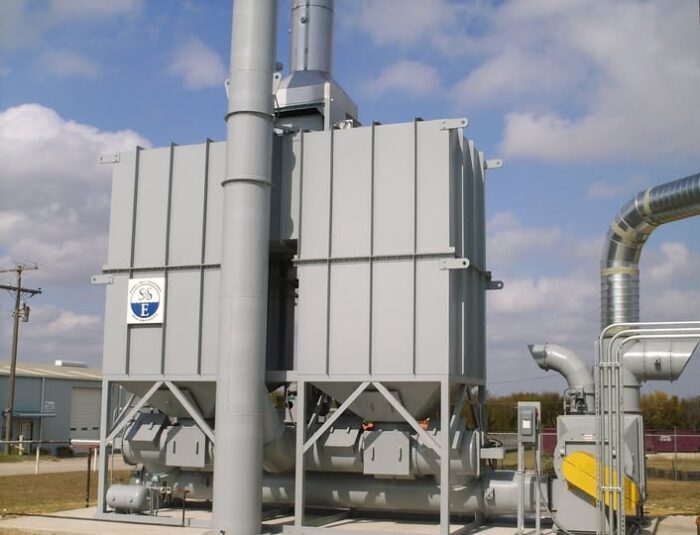
How an RTO Supports Recycling Industry Emissions Control
An RTO heats collected VOC-laden air to an oxidation temperature and uses regenerative ceramic media to capture and reuse thermal energy. This allows the system to destroy VOCs while limiting additional fuel demand. In Ship & Shore’s published recycling case study, the designed system achieved 98% destruction efficiency and greater than 95% thermal effectiveness for the documented application.
The case study also describes a hot gas bypass stack that helps the RTO respond to differing VOC concentrations and maintain a stable oxidation temperature. That type of control may be important when recycling operations change production output or emissions loading.
Industry-Specific Design Considerations
- Variable VOC concentrations and changing production rates
- Mixed solvent streams, including alcohol, MEK, and toluene in the documented project
- Hot gas bypass or other temperature-management strategies
- Capacity planning for production increases and future system additions
- Air-quality permitting, collection efficiency, utility demand, and site constraints
Energy Recovery and Utility Efficiency
Regenerative ceramic media stores and releases heat within the RTO, helping reduce the burner energy required to treat the exhaust stream. Ship & Shore’s recycling case study reports greater than 95% thermal effectiveness and overall utility savings for the documented facility. Actual performance depends on the process stream, VOC loading, operating schedule, and final system design.
Ship & Shore can also evaluate related heat recovery equipment, process changes, and incentive opportunities when those options fit the project. The goal is to control emissions while supporting reliable production and practical operating costs.
Permitting, Expansion, and Long-Term Support
Ship & Shore’s documented recycling project included air-quality permit assistance and provisions for future additions, including potential stack heat exchanger and hot bypass equipment. That project-based approach helps facilities consider both current compliance needs and planned capacity changes.
Ship & Shore provides engineering, fabrication, equipment installation, commissioning, and aftermarket support for industrial emissions control systems. Read the documented recycling RTO case study.
Frequently Asked Questions About Recycling RTOs
What types of recycling emissions can an RTO control?
The answer depends on the facility and process. Ship & Shore’s documented metal recycling project treated VOCs including alcohol, MEK, and toluene. A process review is needed to confirm whether an RTO is appropriate for a different recycling stream.
How does a recycling RTO handle changing VOC concentrations?
System design can include controls and equipment that help manage changing conditions. The Ship & Shore recycling case study describes a hot gas bypass stack used to respond to differing VOC concentrations and support stable oxidation temperature.
Can a recycling RTO be designed for future expansion?
Yes, future capacity and equipment additions can be considered during the engineering phase. The documented Ship & Shore project included provisions for future additions to support increasing production.
What information should a recycling facility provide?
Useful inputs include exhaust flow, VOC composition and concentration, temperature, operating schedule, collection points, production levels, planned expansion, utilities, and permitting requirements. These details help engineers select a practical system configuration.
Related Ship & Shore Resources
Recycling RTO Case Study | Regenerative Thermal Oxidizers | Solvent Recycling and Distillation | Industries Served
Request a project review
Every facility has a different exhaust profile, operating schedule, layout, and permitting context. Ship & Shore Environmental reviews the process data, evaluates the emissions control requirements, and develops a custom solution for the application. Request a quote to begin a conversation with the Ship & Shore engineering team.