
The AI Data Center Boom Is Creating Emissions from Backup Energy Sources, but the Technology to Clean It Up Already Exists
October 12, 2026 1:43 pmThe AI Data Center Boom Is Creating Emissions from Backup Energy Sources, but the Technology to Clean It Up Already Exists
Media Inquiries, please contact:
Beatriz.arana@energiacommunications.com
Download the PDF of this Press Release
Emissions control belongs in data center design, not as an afterthought, as Virginia tightens generator rules.
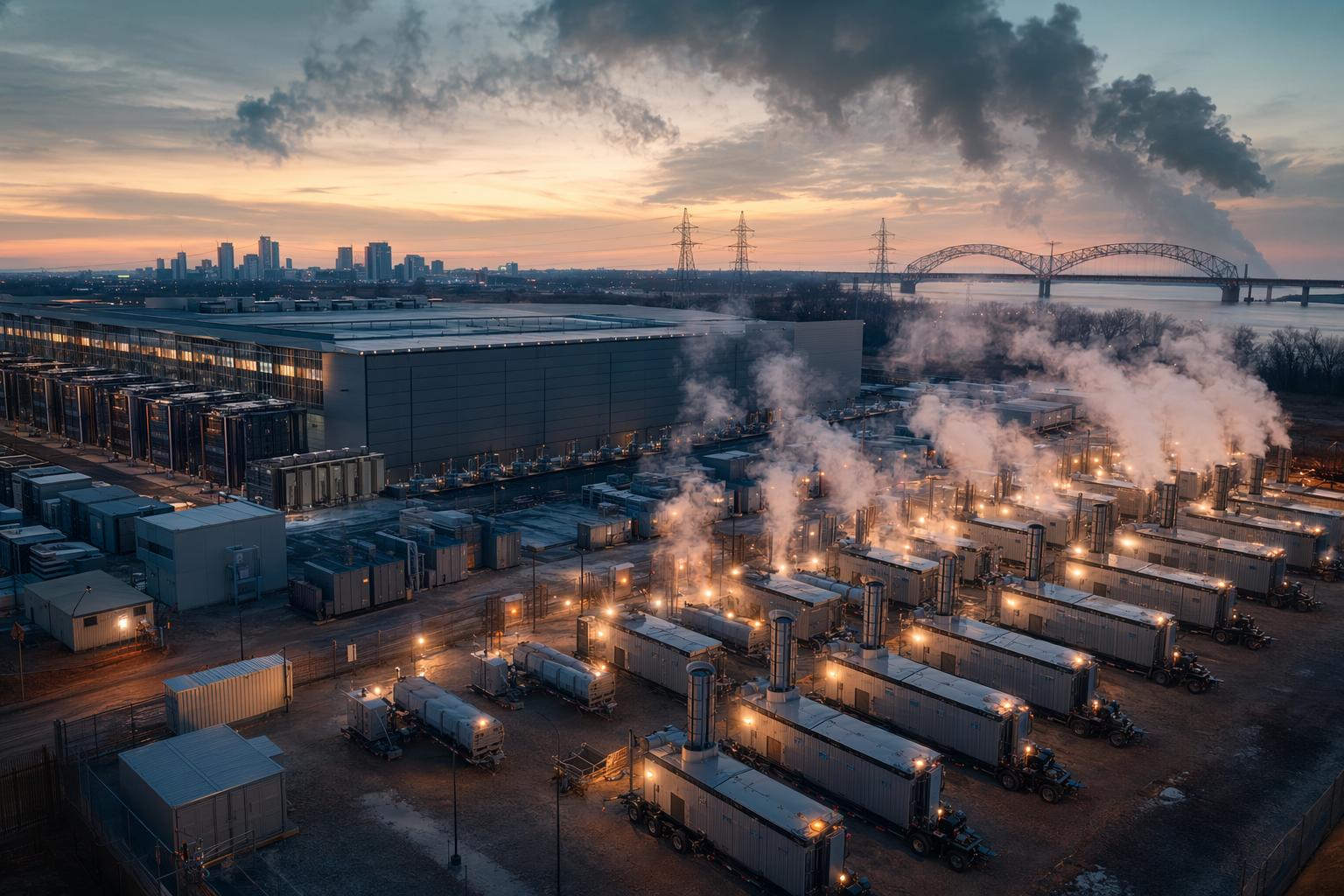
Long Beach, CA, October 13, 2026 – Global electricity demand from data centers is on track to more than double by 2030, with AI as the single largest driver of that growth, according to the International Energy Agency. Less discussed is what that growth means for backup power. Every new data center campus adds not just servers and cooling systems but a fleet of diesel generators standing by to keep operations running through grid outages, and each one is a source of regulated air emissions.
“Backup generators aren’t an afterthought at a data center, they’re required infrastructure,” said Anoosheh Oskouian, CEO of Ship & Shore Environmental, a global provider of industrial air pollution control solutions. “As more of these facilities come online, the emissions from that backup power fleet grow right along with them, and that’s a problem our industry already knows how to solve.”
A Fast-Growing Fleet With a Real Footprint
Northern Virginia alone has more than 9,000 backup generators available to supply emergency power to data centers, according to Virginia Mercury. In Texas, a July 2026 analysis by the Environmental Integrity Project, reported by The Texas Tribune, found 32 new natural gas plants planned specifically to power data centers are projected to emit more than 287 million metric tons of greenhouse gases annually. A separate National Bureau of Economic Research analysis found that Texas and Virginia together account for roughly 30 percent of the national economic damage tied to data center emissions, underscoring how concentrated the impact already is in the regions building the fastest.
That concentration is starting to show up in how these generators are actually used, not just how many exist. In spring and summer 2026, the U.S. Department of Energy issued a series of emergency orders directing data centers in several regions to run their backup generators during periods of extreme grid stress, a shift the EPA now treats as emergency operation exempt from the usual hourly limits on non-emergency use. Oskouian said that trend is worth watching closely.
Backup generators are required infrastructure at data centers, and each one is a regulated source of air emissions. As AI drives demand higher, how those fleets are controlled is becoming part of the design conversation.
“When backup power starts getting called on for grid support and not just outages, the emissions conversation changes,” Oskouian said. “That is exactly why the control technology needs to be built in from the start, not treated as something to revisit later.”
Regulators and Communities Are Paying Closer Attention
Virginia, home to the country’s densest cluster of data centers, passed legislation this year requiring new data center air permits submitted after July 1, 2026 to meet emissions limits at least as strict as Tier 4 generator standards. Separately, the EPA’s Office of Air and Radiation launched a Clean Air Act Resources for Data Centers webpage to help developers navigate permitting requirements for backup power fleets.
“Regulators and communities are asking sharper questions about backup power than they were even a year ago,” Oskouian said. “That’s not a reason to slow down data center development. It’s a reason to bring emissions control into the design conversation from the start.”
Technology That Already Exists
Proven emissions control technologies, including selective catalytic reduction, diesel oxidation catalysts, diesel particulate filters, cleaner fuels and battery storage, can be combined to cut regulated pollutants from backup generators without compromising the reliability data centers depend on. Ship & Shore Environmental designs and engineers these systems for industrial clients across North America, Europe and Asia, tailoring the combination to each facility’s generator fleet, fuel source and local regulatory requirements.
“There is no single solution for every project,” Oskouian said. “The right combination depends on how a facility is built and what its permits require. What matters is treating emissions control as part of the engineering from day one, not something addressed after the fact.”
Early Planning Is the Biggest Lever
Oskouian, a chemical engineer with more than four decades of industrial environmental experience, points to early-stage collaboration between environmental engineers, permitting specialists and developers as the single biggest opportunity to avoid costly redesigns and permitting delays down the line.
“When environmental engineers, permitting specialists and developers work together during facility design, projects can evaluate emissions control strategies, improve permitting certainty and avoid costly redesigns,” Oskouian said. “Responsible environmental planning is not a barrier to innovation. It is part of building resilient infrastructure.”
Community Trust Matters as Much as Compliance
Beyond regulatory compliance, Oskouian said developers who engage nearby communities early, and can speak plainly about how new facilities may affect air quality and noise, are more likely to build trust and avoid project delays.
“Communities deserve transparency,” Oskouian said. “Developers who engage communities early and demonstrate a commitment to responsible engineering are more likely to earn trust while avoiding unnecessary project delays.”
A Pattern With Precedent
Oskouian frames the moment as a familiar one in industrial history. Cleaner manufacturing, cleaner vehicles and cleaner power generation all became possible once engineers treated environmental performance as a design problem to solve rather than a trade-off to accept.
“The question is not whether we should build more data centers,” Oskouian said. “The question is whether we will build them responsibly. By integrating environmental planning, emissions mitigation and engineering excellence into every project from the outset, we can support AI innovation while protecting the communities where these facilities operate.”
About Ship & Shore Environmental, Inc.
Ship & Shore Environmental, Inc. (S&SE) is the leading global provider of industrial emissions control, energy recovery and pollution abatement solutions. With more than 25 years of experience, S&SE designs, engineers, fabricates, installs and services advanced systems for manufacturers across North America, Europe and Asia. The company serves a wide range of industries, including renewable energy, battery manufacturing, oil and gas, product testing, furniture and coatings, and advanced industrial manufacturing.
S&SE is recognized for delivering state-of-the-art, energy-efficient technologies that continuously evolve to meet and exceed both client and government environmental targets. Its solutions include VOC destruction, HAP elimination, dust collection, heat recovery and closed-loop energy systems, helping clients improve operational efficiency, reduce costs and achieve sustainability goals. S&SE also helps manufacturers secure maximum government incentives, making it a global partner for companies seeking resilient, low-emission operations worldwide. For more information, visit www.shipandshore.com or contact info@shipandshore.com.
Categorised in: Air pollution, Energy, EPA, Industry news, Media, Press Release, Ship & Shore, Technology