Anoosheh Oskouian’s Interview in Sustainable Packaging News entitled, “Cleaner air, lower energy demand: tackling emissions in packaging production.”
November 18, 2026 9:30 amAnoosheh Oskouian’s Interview in Sustainable Packaging News entitled, “Cleaner air, lower energy demand: tackling emissions in packaging production.”
Media Inquiries, please contact: Beatriz.arana@energiacommunications.com
Read the Sustainable Packaging News Interview (PDF)
Cleaner packaging production requires manufacturers to address both the pollutants released by their processes and the energy required to control them.
November 18, 2026 – In an exclusive interview with Sustainable Packaging News, Anoosheh Oskouian, President and CEO of Ship & Shore Environmental, discusses how packaging manufacturers can combine emissions capture, thermal oxidation and heat recovery to reduce volatile organic compound (VOC) emissions while controlling energy demand.
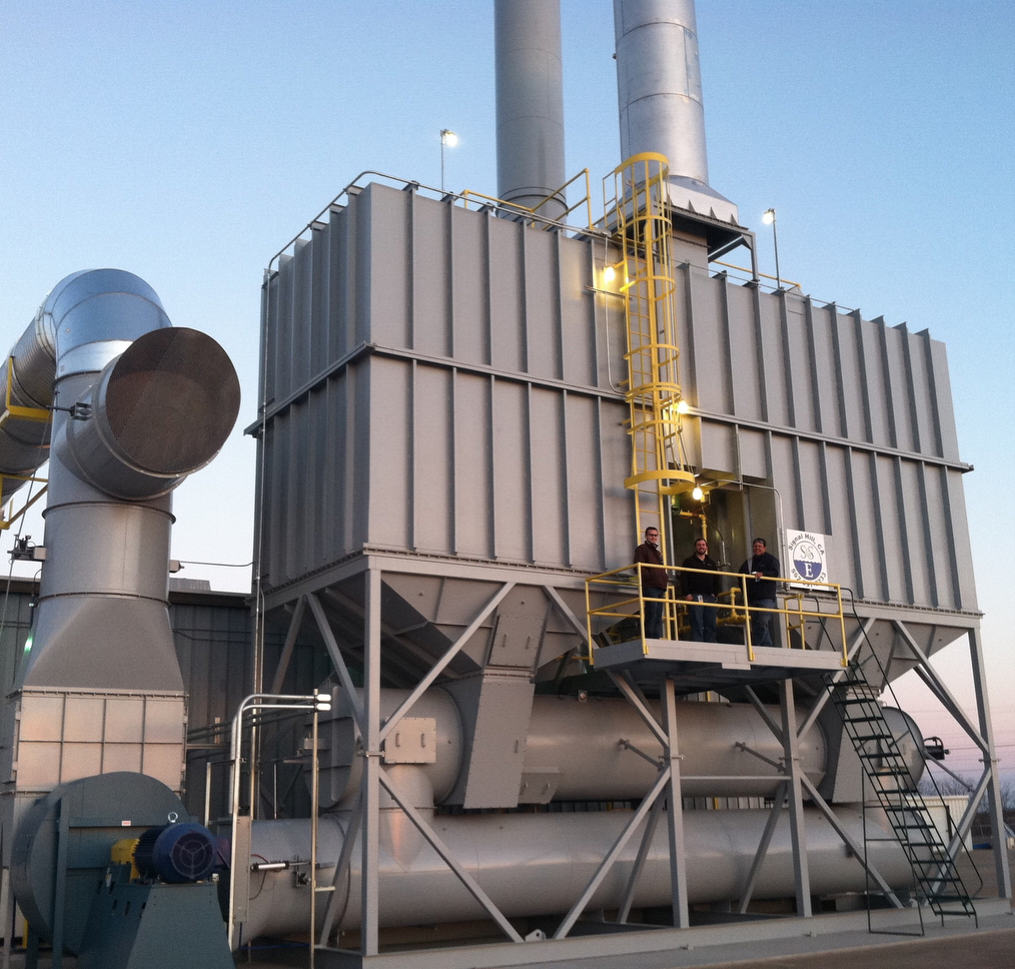
Ship & Shore Environmental engineers regenerative thermal oxidizer systems that destroy VOCs while recovering useful process heat.
Cleaner Air Without an Energy Penalty
Packaging manufacturers face the challenge of expanding sustainable production while reducing carbon emissions, VOCs and operating costs. Oskouian explains that pollution control should be incorporated into long-term production and capital planning rather than treated as a last-minute compliance expense.
For flexible packaging operations, key VOC sources can include printing inks, adhesives, laminates, coatings and equipment-cleaning solvents. Corrugated operations typically have lower VOC loads, but coatings and cleaning agents can still contribute. Permanent total enclosures can capture fugitive emissions around presses and coating lines before routing the exhaust to an appropriately engineered control system.
Thermal Oxidation and Heat Recovery
Regenerative thermal oxidizers can destroy more than 99% of VOCs while ceramic heat-exchange media captures and reuses thermal energy from the treated exhaust. At suitable solvent concentrations, the oxidation process may become self-sustaining and require little or no supplemental fuel.
Catalytic oxidizers can achieve similar destruction performance at lower operating temperatures for compatible, clean exhaust streams. The correct technology depends on process chemistry, airflow, operating conditions and long-term maintenance requirements.
Additional heat recovery can return useful energy to curing ovens, building-heating systems or absorption chillers, helping facilities reduce fossil-fuel demand, Scope 1 emissions and utility costs.
Planning for New Materials and Evolving Regulations
Extended Producer Responsibility policies and tighter air-quality rules are encouraging packaging manufacturers to move from reactive compliance to proactive investment. Changes to water-based inks, bio-adhesives and compostable substrates may reduce baseline VOC emissions, but they can also change drying temperatures, airflow requirements and exhaust chemistry.
Before introducing new materials, Oskouian recommends an engineering review of the exhaust stream and existing control equipment to confirm that the system can accommodate new solvent loads, airflows and production conditions.
Making Cleaner Production Practical
For smaller converters, capital cost and limited floor space can be significant barriers. Modular and scalable pollution-control systems, combined with environmental grants, tax incentives and utility rebates, can help reduce upfront costs and improve the return on investment.
Preventive maintenance, remote monitoring and routine aftermarket service also help manufacturers reduce unplanned downtime, avoid regulatory penalties and maintain reliable emissions-control performance.
About Ship & Shore Environmental, Inc.
Ship & Shore Environmental is a Long Beach, California-based, woman-owned, certified business specializing in air pollution capture and control systems for industrial applications. Since 2000, the company has provided engineering and manufacturing for customized, energy-efficient air pollution abatement systems, with offices in the U.S., Canada, Europe, India, Thailand, China and other locations.
For more information, visit www.shipandshore.com.
Categorised in: Air pollution, Energy, EPA, Flexographic, Green Energy, Industry news, Media, Press Release, Publications, RTO, Ship & Shore, Technical, Technology, VOC Abatement