
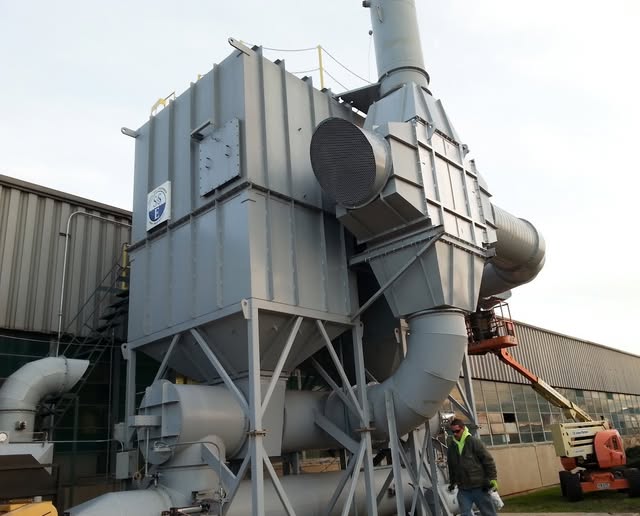
Electric Regenerative Thermal Oxidizer Systems
Ship & Shore Environmental custom-engineers electric RTO systems for efficient volatile organic compound and hazardous air pollutant control without a conventional natural gas-fired auxiliary burner.
- Electric auxiliary heating
- Regenerative heat recovery
- Custom process engineering
- VOC and HAP control
What Is an Electric Regenerative Thermal Oxidizer?
An electric regenerative thermal oxidizer is an industrial air pollution control system that uses high-temperature oxidation to treat applicable volatile organic compounds (VOCs), volatile hazardous air pollutants (HAPs), and odorous emissions. Electric resistance heating elements provide auxiliary heat instead of a conventional gas-fired burner, while regenerative ceramic media captures and reuses heat from the treated exhaust.
The core operating principle is similar to a conventional regenerative thermal oxidizer. The main change is the auxiliary heat source. Ship & Shore evaluates that change together with process chemistry, airflow, utility infrastructure, emissions requirements, and lifecycle economics.
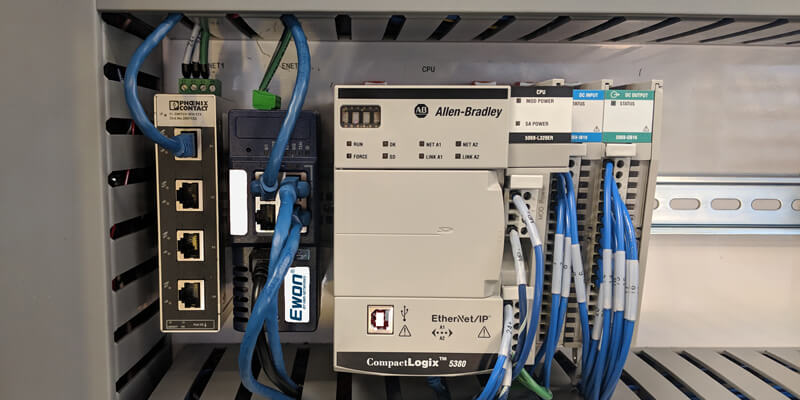
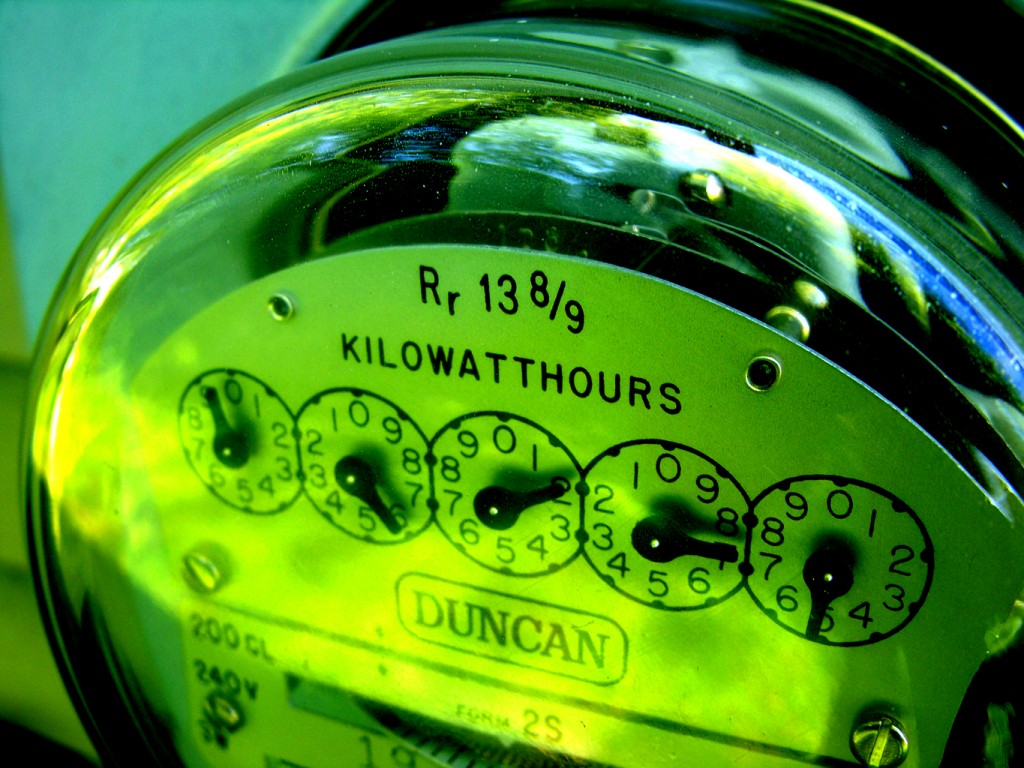
Electric RTO Controls and Power Planning
An electric RTO project extends beyond the oxidation chamber. Heater demand, facility service capacity, switchgear, controls, monitoring, utility rates, and redundancy all affect technical fit and lifecycle cost.
Benefits of Electric RTO Technology
Electric heating can change the emissions profile, utility plan, controls, and maintenance scope of an RTO. The value of each benefit must be confirmed for the facility.
Burner-related emissions
A fully electric design removes direct combustion emissions from a conventional natural gas auxiliary burner.
Scope 1 strategy
Replacing onsite auxiliary fuel combustion may support a facility’s direct Scope 1 reduction plan.
Electricity sourcing
The system can align with renewable electricity procurement, subject to credible Scope 2 accounting.
Gas infrastructure
An all-electric configuration can avoid a dedicated natural gas connection and conventional fuel train.
Component scope
Removing burner-related equipment may simplify portions of maintenance, controls, and commissioning.
Heat recovery
Regenerative ceramic media recovers thermal energy and reduces the auxiliary heat required by the process.
Temperature control
Electric heater modulation can provide precise, responsive control around the engineered oxidation temperature.
Facility electrification
An eRTO can become part of a broader capital plan for process electrification and decarbonization.
Site-specific design
Ship & Shore engineers the chamber, media, heating, controls, and auxiliaries around actual process data.
How Does an Electric RTO Work?
An electric RTO uses alternating ceramic media beds to recover heat while electric elements provide the auxiliary energy needed to reach and maintain the engineered oxidation temperature.
- 1Collect exhaustProcess ventilation captures VOC-laden air.
- 2Direct airflowInlet manifolds and valves route the stream.
- 3Recover heatHot ceramic media preheats incoming air.
- 4Add electric heatElectric elements supply required auxiliary energy.
- 5Oxidize pollutantsTime, temperature, turbulence, and oxygen drive treatment.
- 6Store outgoing heatThe outlet bed absorbs energy from treated air.
- 7Reverse the cycleValves alternate beds for continuous recovery.
Autothermal operation still requires system power
When VOC loading contributes sufficient heat, auxiliary heater demand may be reduced substantially or, under certain operating conditions, temporarily eliminated. Autothermal operation does not eliminate system power: fans, controls, valves, instrumentation, and other components continue to consume electricity. Ship & Shore explains the conventional RTO cycle in its RTO operating guide.
Electric RTO vs. Gas-Fired RTO
Both configurations can use regenerative heat recovery and can be engineered for demanding VOC-control applications. The preferred heat source depends on process requirements, infrastructure, reliability, and lifecycle cost.
| Evaluation factor | Electric RTO | Gas-fired RTO |
|---|---|---|
| Auxiliary heat source | Electric resistance heating elements | Natural gas or another engineered burner fuel |
| Direct burner-related NOx | No conventional gas-burner contribution | Combustion conditions affect burner-related NOx |
| Direct CO2 from auxiliary fuel | No onsite CO2 from auxiliary gas combustion | Auxiliary fuel combustion creates onsite CO2 |
| Upstream energy emissions | Depend on electricity source and accounting method | Include fuel supply impacts beyond onsite combustion |
| Natural gas connection | Not required for a fully electric configuration | Fuel connection and fuel train are generally required |
| Electrical infrastructure | Heater load may require substantial service capacity | Power remains necessary for fans, controls, and auxiliaries |
| Heat recovery | Regenerative ceramic media | Regenerative ceramic media |
| VOC destruction potential | Application-specific system design and operating conditions | Application-specific system design and operating conditions |
| Maintenance focus | Heating elements, electrical distribution, media, valves, fans, and controls | Burner and fuel train plus media, valves, fans, and controls |
| Operating economics | Electric rates, demand charges, runtime, loading, and infrastructure | Fuel rates, runtime, loading, heat recovery, and maintenance |
| Startup and modulation | Defined by heater sizing and electrical design | Defined by burner sizing, controls, and fuel system |
| Best-fit conditions | Strong electrification case and sufficient electrical capacity | Favorable gas economics, capacity, and reliability |
What Emissions Does an Electric RTO Reduce?
Replacing a conventional auxiliary gas burner with electric heating changes where certain emissions occur. It does not make the complete process universally emission-free.
At the oxidizer
A fully electric design removes combustion emissions from the conventional auxiliary gas burner. Overall NOx considerations can still depend on process chemistry, including nitrogen-bearing compounds.
From VOC oxidation
Oxidizing carbon-containing VOCs can produce carbon dioxide and water vapor regardless of whether auxiliary heat comes from electricity or gas.
From purchased electricity
Electricity generation may create upstream emissions. Under the GHG Protocol, onsite fuel combustion is generally Scope 1, while purchased electricity is generally reported as indirect Scope 2 emissions.
Renewable electricity may improve the carbon profile, but the result depends on the electricity source, contractual instruments, and reporting method. Review the GHG Protocol Scope 2 Guidance when quantifying the facility-level change.
When Should a Facility Consider an Electric RTO?
- Burner-related NOx or onsite combustion is a material concern.
- The facility has electrification or direct Scope 1 reduction goals.
- Natural gas service is unavailable, limited, or undesirable.
- Electrical capacity and utility reliability support the projected load.
- Airflow, VOC loading, runtime, and lifecycle economics support electric heating.
- An RTO replacement or major retrofit creates a practical evaluation point.
When Might a Gas-Fired or Hybrid RTO Be More Practical?
A gas-fired or hybrid design may have a stronger lifecycle case when electrical capacity is constrained, transformer or switchgear upgrades are expensive, demand charges are high, electricity-to-gas economics are unfavorable, or fuel redundancy is important.
Very large applications and sites with reliable gas infrastructure also warrant careful comparison. Ship & Shore’s role is to select a defensible lifecycle solution, not to force one heat source into every project.
What Ship & Shore Evaluates Before Designing an Electric RTO
Electrical demand and heater sizing cannot be selected from airflow alone. Ship & Shore evaluates the process stream, operating profile, utilities, permit conditions, and site constraints together.
Process stream
- SCFM or ACFM and temperature
- VOC and HAP composition
- Concentration, variability, and percent LEL
- Moisture and particulate loading
- Corrosive, halogenated, sulfur, nitrogen, or silicone compounds
Performance
- Required destruction removal efficiency
- Permit and testing conditions
- Operating hours and production changes
- Redundancy and shutdown windows
- Pretreatment or downstream treatment needs
Utilities
- Available voltage and amperage
- Transformer and switchgear capacity
- Electric rates and demand charges
- Electricity source and reliability
- Gas availability, rates, and redundancy
Site integration
- Footprint and installation access
- Existing controls and equipment
- Collection ductwork and fan duty
- Planned production growth
- Capital and sustainability objectives
Custom Electric RTO Engineering From Concept Through Commissioning
Ship & Shore combines process engineering, fabrication, installation, commissioning, training, and lifecycle support. Each system is designed around site-specific process and permit conditions.
- Process evaluationCharacterize airflow, contaminants, loading, capture, and operating schedule.
- Technology selectionCompare electric, gas-fired, hybrid, and other appropriate abatement configurations.
- Utility and lifecycle reviewModel RTO energy requirements, infrastructure, rates, demand charges, and reliability.
- Engineering and permitting supportDevelop mechanical, electrical, controls, and compliance-support documentation.
- Fabrication and assemblyCoordinate in-house fabrication and preassembly capabilities.
- Installation and startupPlan equipment installation, commissioning, balancing, and operator training.
- Performance supportSupport testing, operating optimization, controls, and heat-recovery opportunities.
- Lifecycle serviceProvide preventive maintenance, troubleshooting, upgrades, and aftermarket support.
Electric RTO Performance Is Application-Specific
Ship & Shore establishes performance criteria from the pollutant mix, flow, permit, and engineered operating envelope. General RTO figures should not be treated as an electric RTO guarantee.
- Target pollutants
- Application-specific VOCs, volatile HAPs, and odors
- Destruction removal efficiency
- Engineered to project and permit requirements
- Airflow and chamber configuration
- Application-specific
- Oxidation temperature
- Compound- and design-specific
- Ceramic media
- Selected for heat recovery and stream conditions
- Electrical load
- Calculated from process and operating conditions
- Controls and modulation
- Integrated for the engineered operating sequence
- Startup and redundancy
- Defined during project engineering
- Materials of construction
- Selected for chemistry, temperature, and environment
- Available integrations
- Capture systems, heat recovery, monitoring, and controls
Industrial Applications for Electric RTO Systems
Electric RTO technology may be considered for VOC-generating processes in the following industries when process chemistry, loading, utilities, and permit needs support the configuration.
Engineering Experience Behind Every Ship & Shore System
Ship & Shore Environmental designs and manufactures industrial air pollution control systems through a coordinated team spanning engineering, fabrication, installation, commissioning, and service. The company reports more than 1,000 custom systems installed across more than 35 industries during over 25 years of operation. Those are company-wide figures and do not represent electric RTO installations alone.
Review Ship & Shore’s engineering leadership, air pollution control case studies, and the company’s electric RTO announcement for additional context.
Page updated: August 28, 2026. Technical reviewer attribution will be added after Ship & Shore approval.
Frequently Asked Questions About Electric RTO Systems
What is an electric regenerative thermal oxidizer?
An electric regenerative thermal oxidizer is an industrial air pollution control system that uses electric heating elements, high-temperature oxidation, and regenerative ceramic media to treat applicable VOCs, volatile HAPs, and odorous emissions. The ceramic beds recover heat from treated air and transfer it to the incoming stream, reducing the auxiliary heat the process requires.
How does an electric RTO work?
VOC-laden process air passes through a heated ceramic media bed, which raises its temperature before it enters the oxidation chamber. Electric elements supply any additional heat needed for treatment. The hot treated air then transfers heat to a second ceramic bed. Flow-control valves reverse the direction so the beds alternate between preheating and heat recovery.
How is an electric RTO different from a gas-fired RTO?
The primary difference is the auxiliary heat source. An electric RTO uses electric heating elements, while a gas-fired RTO uses a burner and fuel train. Both can use regenerative ceramic media and similar flow-reversal principles. Infrastructure, emissions accounting, maintenance scope, startup behavior, reliability planning, and operating economics can differ materially between the two configurations.
Does an electric RTO eliminate NOx emissions?
A fully electric RTO removes the direct NOx contribution from a conventional natural gas auxiliary burner because that burner is not present. That change does not establish total system NOx at zero. Nitrogen-bearing compounds in the process stream and other process-specific conditions may affect total system or facility NOx considerations.
Does an electric RTO produce CO2?
Yes, carbon-containing VOCs can oxidize into carbon dioxide and water vapor regardless of the auxiliary heat source. An all-electric RTO avoids onsite CO2 from burning natural gas for auxiliary heat, but purchased electricity can have upstream emissions. The total carbon impact depends on the process stream, electricity source, operating conditions, and accounting boundary.
Can an electric RTO operate without continuous auxiliary heating?
Possibly. If the VOC loading contributes enough heat, auxiliary electric heater demand may be reduced substantially or, under certain engineered conditions, temporarily eliminated. The entire system does not stop using electricity. Fans, valves, controls, instrumentation, and safety systems continue to require power while the RTO operates.
Does an electric RTO use less energy?
Not automatically. Regenerative ceramic media can reduce auxiliary heat demand, but total energy use depends on airflow, inlet temperature, VOC loading, heat recovery, pressure drop, operating schedule, controls, and system design. A defensible comparison must include both heater energy and the power used by fans, valves, controls, and ancillary equipment.
Is an electric RTO less expensive to operate?
Operating cost is application-specific. Electricity rates, natural gas rates, demand charges, runtime, VOC loading, heat recovery, maintenance, and electrical infrastructure all affect lifecycle economics. Ship & Shore compares electric, gas-fired, and hybrid options using utility data and the operating profile supplied by the facility rather than assuming one configuration will always cost less.
How much electrical capacity does an electric RTO require?
There is no reliable universal number. Required capacity depends on airflow, inlet temperature, target operating temperature, VOC loading, heat recovery, startup strategy, heater modulation, redundancy, and ambient design conditions. Available voltage, amperage, transformer capacity, switchgear, utility lead time, and demand charges must be evaluated before equipment selection.
Can an existing gas-fired RTO be converted to electric?
A conversion may be technically possible, but it is not a simple burner substitution in every case. Ship & Shore would evaluate chamber geometry, heater integration, electrical service, controls, safety systems, media condition, fan capacity, permit implications, installation access, and remaining equipment life before recommending conversion, hybridization, or replacement.
What destruction efficiency can an electric RTO achieve?
Destruction removal efficiency is established for the specific process and design. It depends on temperature, residence time, turbulence, oxygen, compound type, concentration, mixing, and system condition. Ship & Shore does not apply a general RTO percentage to every electric configuration. Project criteria should be tied to permit requirements and performance testing.
Which industries are suitable for electric RTO technology?
Electric RTOs may be evaluated for electronics, semiconductors, battery manufacturing, printing, packaging, coatings, chemicals, pharmaceuticals, automotive, composites, plastics, polymers, food processing, and other VOC-generating operations. Industry alone does not determine fit. Process chemistry, airflow, loading, utilities, runtime, and permit conditions are more decisive.
Is an electric RTO the same as a flameless RTO?
Not necessarily. Some suppliers use flameless as a broad description for equipment without a conventional burner flame. Ship & Shore has a separate flameless regenerative thermal oxidizer service offering, so eRTO and FRTO should not be treated as automatic synonyms. The actual heating method and oxidation design should be confirmed for each project.
How does Ship & Shore determine whether an electric RTO is appropriate?
Ship & Shore reviews the exhaust stream, pollutant composition, airflow, required DRE, permit conditions, operating schedule, electrical service, gas availability, utility costs, site constraints, capital plan, reliability requirements, and sustainability objectives. The team then compares electric, gas-fired, hybrid, and other suitable abatement technologies on technical and lifecycle grounds.
Is an Electric RTO Right for Your Facility?
Ship & Shore can evaluate process conditions, VOC loading, required DRE, electrical infrastructure, gas availability, utility costs, capital requirements, compliance objectives, and sustainability goals. The result may support an electric, gas-fired, hybrid, or other project-specific configuration.