
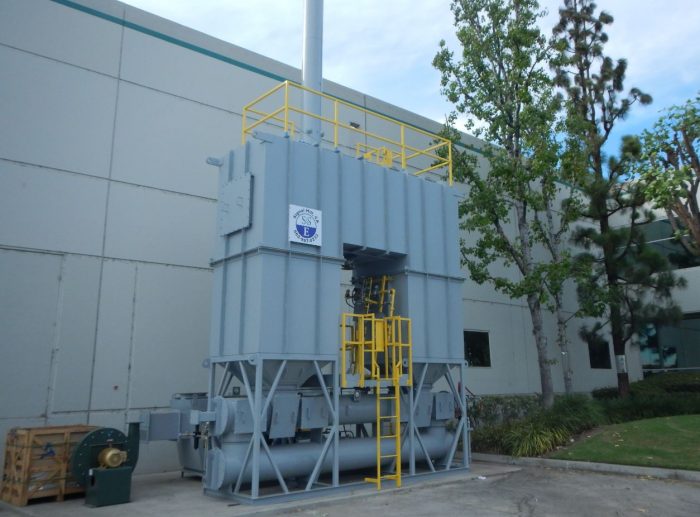
RTO & Odor Control Systems for Rendering Plants
Ship & Shore Environmental engineers RTO and integrated odor-control systems for applicable rendering-process exhaust. We evaluate cooker and dryer emissions, source capture, moisture, grease and organic loading to determine the right combination of pretreatment, oxidation and supporting equipment.
- Cooker and dryer exhaust
- Source capture and odor control
- Stream-specific pretreatment
- Lifecycle service support
Where an RTO Fits in Rendering Odor Control
A rendering-plant regenerative thermal oxidizer uses controlled thermal oxidation to treat suitable organic compounds in collected process exhaust. Ceramic media recovers heat from the treated gas and transfers it to incoming air. Effective plant-wide odor control also requires containment, collection and appropriate exhaust conditioning.
Meat, poultry and animal by-product rendering can involve receiving, cooking, separating, drying, cooling and storage. Those sources differ in airflow, moisture and odor intensity. The best solution may combine an oxidizer with other treatment methods rather than route every source through one device.
Design the Whole System
- Identify process sources separately from building ventilation.
- Characterize odor-causing compounds and peak operating loads.
- Manage grease, droplets and condensables before they foul equipment.
- Coordinate source capture, treatment and ongoing maintenance.
Rendering Sources and Treatment Considerations
An emissions inventory helps distinguish concentrated process exhaust from larger, more dilute air streams. This distinction affects equipment selection, energy demand and overall capture.
| Source | Potential concern | Design question |
|---|---|---|
| Cookers and process vessels | Hot, moisture-rich vapor and variable organic odor loads. | Which vapors should be condensed, conditioned or sent to oxidation? |
| Dryers and thermal processing | Organic vapors, entrained particles and changing temperature. | What separation and operating controls are needed to protect downstream equipment? |
| Receiving and material handling | Diffuse odors and changing raw-material conditions. | Can enclosure and local capture reduce uncontrolled release? |
| Pressing, separation and cooling | Process-specific odors, oil mist and aerosols. | Should these flows share treatment with the cooker or use a separate approach? |
| Building ventilation and storage | Large, dilute flows with multiple odor sources. | Would segregation or another treatment technology be more practical? |
Capture, Pretreatment and Technology Selection
Capture at the Source
Enclosures, hoods and balanced ductwork direct exhaust toward treatment. Collection-system design should account for building pressure, access openings and production changes. An RTO cannot treat emissions that never reach it.
Protect the Treatment Train
Grease, droplets and condensables can restrict airflow and foul heat-transfer media. Separation or other conditioning may be needed. Maintenance access, drainage and waste handling belong in the initial design review.
Match Chemistry to Control
Different compounds respond differently to treatment. Scrubbers and oxidation may serve different sources or operate in a coordinated train. Sulfur-, nitrogen- or halogen-containing streams require a review of possible secondary emissions and corrosion.
SSE’s odor-control and abatement services address treatment selection around facility conditions. A generic VOC destruction figure should not be treated as a guarantee of odor reduction for a mixed rendering stream.
Documented Ship & Shore Rendering Experience
Our published food-manufacturing applications include a pork-fat rendering facility that installed a 5,000 SCFM Ship & Shore RTO to treat cooking-oil and meat-rendering emissions.
This example demonstrates relevant application experience. It does not identify the correct airflow, pretreatment arrangement or performance specification for a different facility. Those decisions require the actual plant’s process and emissions data.
Energy Recovery and Reliable Operation
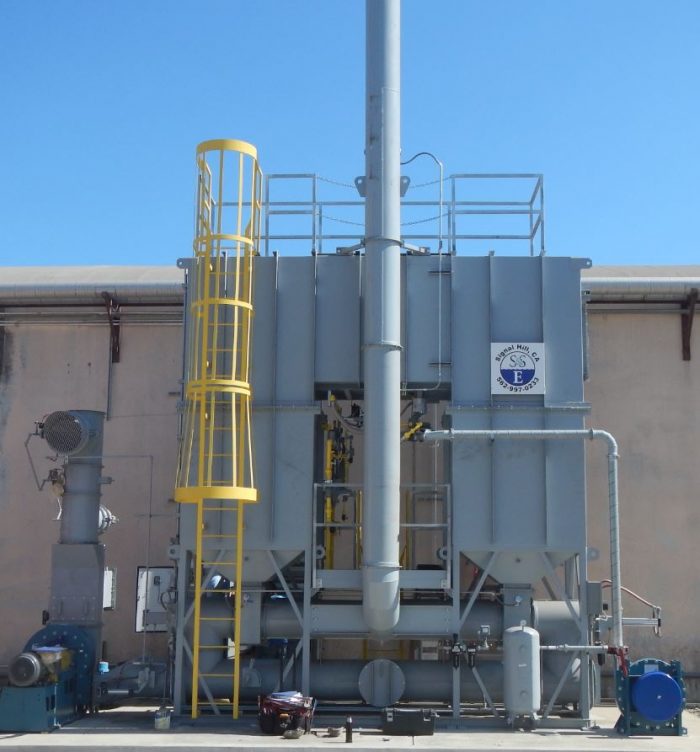
Regenerative heat recovery is part of the RTO’s operating cycle. Additional heat-recovery equipment may be useful where recoverable energy matches a facility demand. Moisture, excess ventilation air, operating hours and contaminant loading all affect the energy balance.
Normal operation is only part of the design basis. Include cold starts, cleaning, production interruptions, seasonal conditions and peak throughput. Fans, valves, controls and interlocks must support a defined operating range. Inspection and cleaning provisions help manage fouling and changing pressure drop.
Aftermarket service and maintenance and equipment-installation support should be considered alongside equipment selection, particularly when a retrofit must fit a limited outage window.
Prepare for a Rendering-Plant Emissions Review
Characterize Each Source
- Raw-material types, throughput and batch or continuous operation.
- Measured airflow, temperature, moisture and peak variations.
- Available chemical, VOC and odor-testing data.
- Grease, aerosols, particulate, condensables and corrosive constituents.
Define the Project Constraints
- Existing controls, ductwork, capture efficiency and building ventilation.
- Permit limits, testing obligations and odor-management objectives.
- Utility capacity, treatment-residual handling and available footprint.
- Maintenance access, installation timing and future expansion.
Our air-pollution-control design services can help translate these inputs into a treatment concept. EPA’s rendering-industry emissions background provides technical context. Facility-specific regulatory applicability and required test methods should be confirmed with the permitting authority.
Rendering Plant Odor Control FAQs
Can an RTO control rendering-plant odors?
An RTO can treat suitable captured organic odor compounds when designed for the actual gas composition and operating range. It will not address uncaptured emissions elsewhere on the site, and not every odor constituent is best treated by oxidation. Source mapping and exhaust characterization come first.
What experience does Ship & Shore have with rendering?
Ship & Shore publishes a food-industry application involving a 5,000 SCFM RTO installed at a pork-fat rendering facility to treat cooking-oil and meat-rendering emissions. That example does not establish the required size or guaranteed performance for another plant.
Does wet or greasy rendering exhaust need pretreatment?
It may. Droplets, grease, particulate and condensable material can foul equipment. Depending on the stream, the treatment train may require condensation, separation, filtration, scrubbing or other conditioning before an oxidizer. The appropriate sequence is determined from process data.
Should all rendering exhaust go to one RTO?
Not necessarily. High-intensity cooker or dryer sources and dilute building ventilation may need different collection and treatment strategies. Combining them can increase airflow and energy demand or introduce incompatible compounds. Each source should be evaluated before combining ducts.
Can a scrubber replace an RTO at a rendering plant?
Sometimes a scrubber or another technology is a better fit for a particular compound or stream. Scrubbing and oxidation remove pollutants by different mechanisms and can also be used in a coordinated treatment train. Selection depends on chemistry, odor goals, utilities, wastewater handling and permit conditions.
Will an RTO eliminate every odor complaint?
No technology should be represented as a guarantee against all complaints. Overall results depend on source containment, collection efficiency, process housekeeping, treatment performance and other site emissions. A complete odor-control plan must address those factors together.
What data are needed for a rendering emissions review?
Provide the source list, production rates, airflow and temperature, moisture and condensables, odor or chemical testing, raw-material variability, operating schedule, existing controls, permit requirements and site layout. Include normal operation, startup, shutdown and cleaning conditions.
Discuss Your Emissions-Control Project
Share your process, available exhaust data and project goals with Ship & Shore Environmental. We can help evaluate the next steps for a new system, expansion or replacement.
Explore all industries served or RTO terminology and design concepts.