
#TechTalk: From Sunlight to Second Life: Engineering a Cleaner Solar Future
September 23, 2026 8:46 am#TechTalk: From Sunlight to Second Life: Engineering a Cleaner Solar Future
Solar power is a source of energy, but producing and recycling photovoltaic (PV) modules can create complex air emissions challenges. As U.S. solar manufacturing expands and more modules reach end of life, emissions management is essential to a sustainable lifecycle.
Air Emissions in PV Manufacturing
PV manufacturing includes cell treatment, coating, metallization, curing, lamination, and module assembly. Depending on the technology and chemistry, these processes can generate VOCs, hazardous air pollutants (HAPs), acid gases, particulate matter, and combustion-related emissions. Some thin-film technologies may also involve cadmium compounds.
No two exhaust streams are necessarily alike. Flow rate, temperature, concentration, chemistry, and particulate loading can vary. Effective control starts with understanding the process and matching treatment to its operating conditions.
Matching Treatment to the Exhaust Stream
For VOC- and organic-HAP-containing streams, regenerative thermal oxidizers (RTOs) and direct-fired thermal oxidizers (DFTOs) can provide high destruction efficiency. High-volume, lower-concentration streams may benefit from VOC concentration before thermal treatment, while heat recovery can reduce energy requirements. Acidic or corrosive compounds may require wet or dry scrubbing.
Managing Emissions During PV Recycling
The challenge continues when PV modules reach end of life. Dismantling, crushing, shredding, milling, and separation can generate dust and fine particulate emissions. Source capture and dust collection can control emissions near the point of generation.
Thermal delamination and other heat-based processes create additional concerns. Heating polymeric encapsulants and backsheets can release VOCs and potentially hazardous or corrosive compounds. Certain fluoropolymer-containing materials may also generate fluorinated compounds, including hydrogen fluoride (HF), requiring treatment matched to the exhaust chemistry.
Engineering a Cleaner Solar Lifecycle
Material recovery and emissions control should be engineered together. The goal is to recover glass, aluminum, copper, and silicon while responsibly managing emissions.
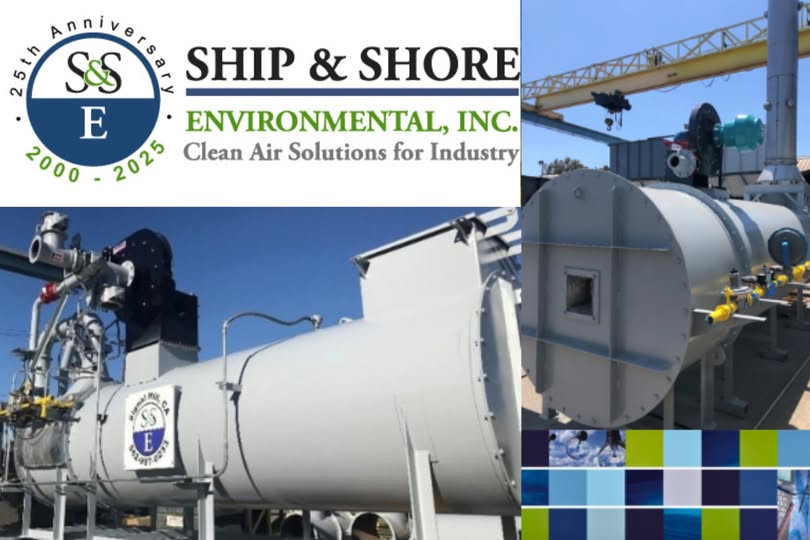
Ship & Shore Environmental provides custom-engineered air pollution control solutions for PV manufacturing and recycling, including source capture, dust collection, RTOs, DFTOs, VOC concentration, scrubbers, heat recovery, permitting, installation, commissioning, and aftermarket service.
As the solar industry moves toward a more circular lifecycle, emissions control should be part of process design from the beginning, supporting cleaner, more efficient, and compliant operations.
For further assistance, please call us at +1 (562) 997-0233 or email service@shipandshore.com.
#TechTalks #SolarEnergy #SolarManufacturing #PVRecycling #AirPollutionControl #VOCControl #RTO
Categorised in: Air pollution, Industry news, News, News, Ship & Shore, TechTalk, VOC Abatement