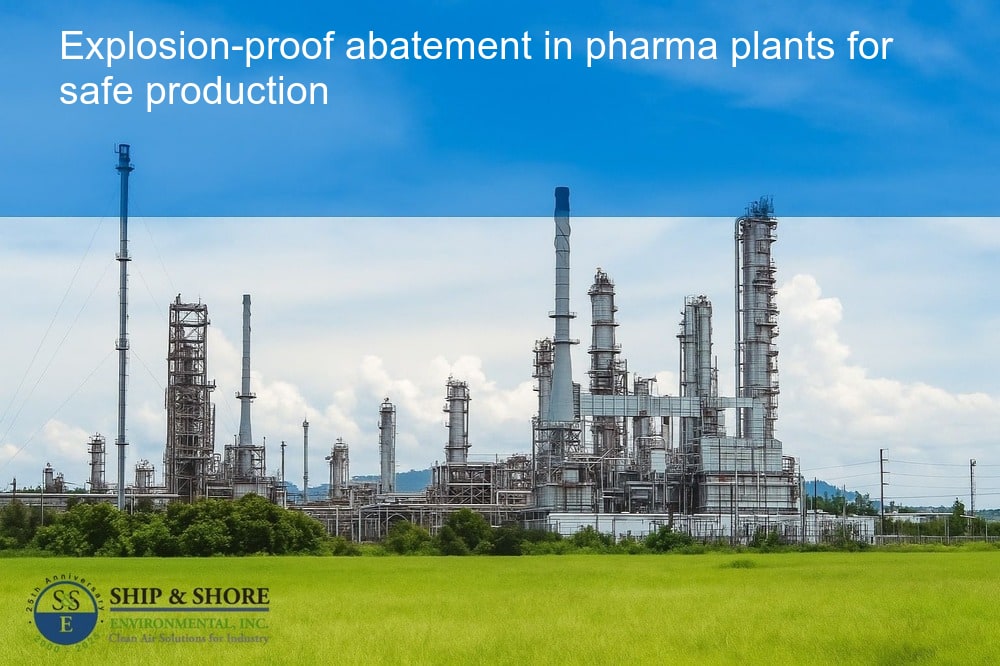
Explosion-proof abatement in pharma plants for safe production
October 16, 2026 4:25 amExplosion-Proof Abatement in Pharma Plants: Addressing Unique Challenges
Explosion-proof abatement in pharma plants is more than just a regulatory requirement; it’s a mission-critical aspect of safe and sustainable pharmaceutical manufacturing. With the ever-rising complexity of production processes and the utilization of volatile organic compounds (VOCs), the stakes for ensuring a safe, compliant, and environmentally responsible facility have never been higher. At Ship & Shore Environmental, we recognize the pivotal role emission control plays in pharma settings where explosive atmospheres frequently occur. As we explore the landscape of abatement challenges, solutions, and future trends, it’s clear that choosing the right technology and partner is key to safeguarding both people and processes.
Understanding Abatement Challenges in Pharmaceutical Manufacturing
Pharmaceutical production involves a wide range of processes—solvent recovery, tablet coating, chemical synthesis, and more—each posing unique abatement challenges. The generation of hazardous emissions, including VOCs, particulates, and toxic gases, is a primary concern. These emissions stem from usage of various organic solvents and chemicals required to synthesize active pharmaceutical ingredients (APIs) and finished dosage forms.
A central challenge is the inherent risk of explosions due to the presence of flammable solvents. Even small concentrations of certain vapors or dust can create dangerous conditions. In addition, the frequent batch-based nature of many pharma operations leads to fluctuating emission concentrations. Such variability complicates the selection and sizing of explosion-proof abatement systems. Energy efficiency, high uptime demands, strict regulatory constraints, and limited facility space further add to the complexity. Our experience tells us that every facility’s needs are unique, and success hinges on customizing solutions to process-specific requirements and risk profiles.
Why Explosion Risks are Critical in Pharmaceutical Environments
Explosion hazards are ever-present in pharma plants due to the combination of highly flammable vapors, fine particulates, and oxygen-rich atmospheres. Mixing, drying, coating, and formulation steps can all elevate risk. According to safety advisories from organizations like OSHA, even a minor ignition source—such as static electricity, hot surfaces, or electrical sparks—can lead to devastating explosions in confined production areas.
Managing these risks calls for robust explosion mitigation strategies that extend far beyond conventional emission control. Explosion-proof abatement in pharma plants integrates specialized technologies such as pressure relief systems, flame arrestors, and intrinsically safe electrical designs. This ensures that any potential ignition event within an abatement device or ductwork does not propagate beyond safe boundaries. We focus on technologies able to safely contain, vent, or dissipate explosive forces, offering peace of mind for plant operators and EHS managers alike.
Proactive risk assessments, rigorous operator training, and regular system maintenance are also crucial. Recent trends show growing demand for turnkey emission control packages that address both VOC removal and explosion hazards in a single solution, minimizing operational risk and simplifying compliance efforts. For more information on occupational safety requirements in explosive environments, see this OSHA publication.
Explosion-Proof Abatement in Pharma Plants: Key Technologies and Compliance Standards
Explosion-proof abatement systems in pharma plants must satisfy stringent safety and environmental regulations. The abatement unit itself, as well as every upstream and downstream component, should be rated for use in Class 1, Division 1 or 2 hazardous locations according to the National Electrical Code (NEC) and ATEX/IECEx standards. Selecting the right technology can make the difference between seamless compliance and unforeseen risk.
Innovative Technologies Driving Explosion-Proof Abatement
A range of scalable abatement solutions is available, each with distinct benefits for controlling emissions in pharma applications:
- Regenerative Thermal Oxidizers (RTOs) with explosion-proof upgrades destroy VOCs at high temperatures, offering high efficiency and predictable performance.
- Flameless Regenerative Thermal Oxidizers (FRTOs) leverage advanced burner designs and heat exchange, reducing risk of flame propagation and enabling high VOC destruction with lower NOx emissions. Explore our FRTOS solutions.
- Custom VOC abatement systems designed for specific process workflows integrate multiple explosion-mitigation safeguards, including fast-acting dampers, blast panels, and automatic shutdown protocols.
- Dust collection systems equipped with anti-static filtration and venting ensure safe handling of hazardous pharmaceutical powders, minimizing the risk of secondary explosions.
Each technology demands careful engineering. For example, RTOs designed for hazardous areas must have spark-resistant fans, explosion venting, and continuous gas monitoring. Custom PLC-based controls coordinate fail-safe shutdown and operator notifications. These features are standard in our integrated solutions, giving you confidence in both safety and compliance.
Industry Standards and Compliance Requirements
Explosion-proof abatement in pharma plants aligns with several regulatory frameworks. In the United States, NFPA standards—including NFPA 69 (Explosion Prevention Systems) and NFPA 86 (Ovens and Furnaces)—are foundational. International operations must also consider ATEX Directive 2014/34/EU and relevant ISO quality standards.
Beyond physical equipment, facilities must document process safety measures, conduct routine hazard analyses, and prove ongoing abatement system performance via stack testing and emissions monitoring. Working with an experienced provider ensures that all design, installation, and maintenance aspects stay current with evolving global regulations.
Our air pollution abatement system design services tackle these compliance challenges head-on, combining field expertise with advanced modeling to recommend right-sized, future-ready solutions.
Explosion-Proof Emission Control Solutions: Delivering Benefits and Results
Implementing explosion-proof abatement in pharma plants delivers far-reaching advantages, both operationally and environmentally. First and foremost, these systems protect personnel, property, and critical infrastructure from the catastrophic consequences of unintentional ignition. By eliminating the conditions that allow dangerous explosive atmospheres to develop or propagate, we reduce the risk of costly downtime, product loss, and regulatory penalties.
High-efficiency emission control further safeguards brand reputation and enables proactive compliance with EPA, state, and international clean air mandates—critical for supply chain certification and public trust. With Ship & Shore’s VOC abatement expertise, our clients routinely achieve >99% destruction removal efficiency (DRE) for hazardous air pollutants. Our energy and operational cost savings also make these advanced systems a sound investment, often with quick payback periods due to reduced insurance premiums and maintenance needs.
Integrated explosion-proof abatement systems fit seamlessly with modern control architecture, offering features like remote monitoring, predictive maintenance alerts, and automated reporting. The result is a safer, cleaner, and more competitive manufacturing environment.
Why Choose Ship & Shore Environmental for Your Pharma Plant?
Our holistic approach means no detail is overlooked. Whether installing a new regenerative thermal oxidizer for process off-gases, updating aging dust collection units, or performing a plant-wide emission audit, our team guides every step—from initial risk assessment to commissioning and ongoing training. If you’re looking to futureproof your operations, contact us for a custom system analysis or explore our comprehensive offering of emission control technologies.
Future Trends and Effective Implementation Strategies for Explosion-Proof Abatement
The landscape for explosion-proof abatement in pharma plants is evolving rapidly. Digitalization, automation, and stricter sustainability metrics are reshaping plant operations worldwide. Tomorrow’s emission control strategies will be increasingly data-driven, leveraging real-time gas sensors, AI-powered process controls, and IoT-connected devices to predict and prevent abnormal conditions before they arise.
Novel abatement technologies, such as modular flameless oxidizers and advanced adsorption media, are raising destruction efficiencies while reducing environmental impacts. Energy recovery from exhaust streams is now a key driver, turning “waste” heat into a resource to power other plant processes. Flexible, modular systems are especially well-suited for pharma’s frequent product changeovers and varying load conditions.
To remain ahead, plants must adopt agile, future-ready solutions designed for easy scalability and rapid adaptation. We recommend a holistic project approach—comprehensive hazard analysis, careful equipment sizing, redundancy for critical safety systems, and staff training to ensure optimal operation. Implementation does not end at startup; ongoing review and periodic system upgrades are essential to manage changing regulatory landscapes and evolving process requirements.
Above all, partnership matters. By working with a trusted abatement specialist with deep pharma expertise, you’ll gain access to best-in-class service, new technology insights, and a support team committed to your safety and compliance success. Ready to advance your plant safety and performance? Contact us to schedule a free compliance and risk assessment.
Together, Shaping a Safe and Sustainable Future in Pharma Manufacturing
Explosion-proof abatement in pharma plants isn’t just about meeting today’s standards—it’s about building resilient, efficient, and sustainable operations well into the future. As regulatory scrutiny intensifies and pharma processes continue to grow in complexity, the role of expertly engineered, explosion-proof abatement solutions will only increase.
By focusing on operational safety, environmental compliance, and technological innovation, we help clients minimize risk and maximize return on investment. With our in-depth expertise in VOC abatement, dust collection, and regenerative thermal oxidation, Ship & Shore Environmental delivers advanced, customized emission control solutions tailored to your specific needs. Explore our regenerative thermal oxidizer and dust collector technologies, or learn more about our system design services for comprehensive coverage.
Whether you’re planning a retrofit, commissioning a new facility, or seeking to futureproof your operations against emerging regulatory and safety demands, our team stands ready to help. Let’s build a cleaner, safer tomorrow together—reach out today for a free site assessment and systems consultation.
FAQ
What are the main abatement challenges in pharmaceutical plants?
Pharmaceutical facilities often handle volatile chemicals and organic compounds, which can create hazardous emissions. As a result, controlling these emissions without risking explosions is a major challenge. In addition, stringent regulations and the need for uninterrupted operations add complexity to effective abatement strategies.
Why is explosion-proof abatement in pharma plants so critical?
Explosion risks are heightened in pharma plants due to the presence of flammable vapors and dust. For this reason, explosion-proof abatement systems are essential to safeguard staff, maintain facility integrity, and ensure compliance with industry standards. By prioritizing safety, we ultimately protect both people and assets.
What key factors should be considered when choosing explosion-proof abatement solutions?
It is important to evaluate the types of emissions, operational conditions, and the plant’s specific risk profile. For example, we always consider airflow rates, concentration of volatile substances, and compatibility with regulatory guidelines. Additionally, the durability and automation capabilities of the system are crucial for efficient ongoing operations.
Which technologies are available for explosion-proof emission control in pharma plants?
There are several advanced technologies for explosion-proof abatement in pharma plants, including thermal oxidizers, catalytic oxidizers, and wet scrubbers with built-in explosion protection. At Ship & Shore Environmental, we offer custom-engineered solutions tailored to each plant’s needs, ensuring both safety and compliance.
How do compliance standards impact pharma plant abatement systems?
Compliance standards ensure that abatement systems effectively control emissions while minimizing explosion risks. Regulatory agencies update guidelines regularly, so it’s vital to stay current and adapt abatement strategies accordingly. Partners like Ship & Shore Environmental provide expertise to ensure ongoing compliance and operational excellence.
Categorised in: Blog