Southern California RTO engineering near Long Beach
Custom RTO Systems for Long Beach Facilities
Ship & Shore Environmental designs and manufactures custom regenerative thermal oxidizer systems for Long Beach facilities that need dependable control of VOCs, HAPs, and process odors. The company is headquartered at 2474 N. Palm Drive in Signal Hill, immediately adjacent to Long Beach, so local project teams can work with a Southern California RTO manufacturer whose engineers, fabrication operations, and service coordination are based nearby.
Long Beach combines port-related industry, advanced manufacturing, aerospace, printing, coating, composites, and a growing space economy. The city’s economic-development program identifies aerospace, goods movement, and advanced manufacturing as growth sectors and describes the local space cluster as “Space Beach.” Those operations can generate very different exhaust profiles: steady dryer air from web processes, intermittent solvent peaks from cleaning or coating, resin and adhesive vapors from composite work, and multiple low-volume capture points spread across a plant.
Grow Long Beach identifies aerospace, goods movement, and advanced manufacturing. Facility-specific zoning, permitting, and operating requirements should always be confirmed with the responsible agencies and qualified advisors.
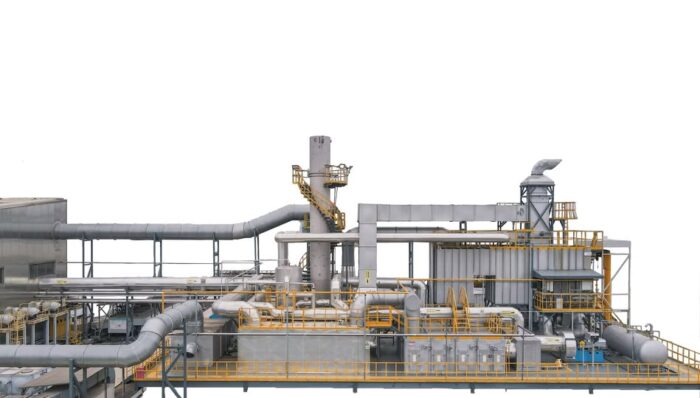

Representative Ship & Shore RTO and industrial application imagery.
Where an RTO May Fit
Common Long Beach applications to evaluate include:
- flexographic printing and package converting
- aerospace coating, composite, and bonding operations
- industrial painting and curing ovens
- solvent cleaning and parts preparation
- adhesive, resin, or chemical-processing exhaust
An RTO is not automatically the right control device for every exhaust stream. Airflow, chemistry, concentration, temperature, particulate, corrosives, production variability, permit limits, energy goals, and lifecycle cost should be compared before the control strategy is selected.
Engineering the Real Operating Case
A Long Beach RTO project should begin with measurements from the actual process. Ship & Shore reviews minimum, normal, and maximum airflow; each VOC or HAP constituent; normal and peak loading; exhaust temperature and moisture; particulates or corrosives; shift patterns; future production; and required control efficiency. For port-adjacent or tightly developed industrial sites, the engineering review should also account for equipment access, crane position, delivery route, noise, stack routing, utilities, marine exposure, and maintenance clearances.
Learn how airflow in SCFM, VOC loading, and lower explosive limit affect the design basis.
Regional access without a fictional branch office
A Southern California RTO Manufacturer Near Long Beach
Because Signal Hill is surrounded by Long Beach, proximity can make early site walks, design reviews, installation coordination, operator training, and planned maintenance easier to schedule than they would be with a distant supplier. It also gives facility teams a practical way to bring process, EHS, maintenance, and engineering stakeholders into the same conversation. Availability and response timing remain project-specific, but the team and headquarters are local rather than represented as a remote branch.
For an operating Long Beach plant, field planning is as important as the oxidizer itself. Existing ductwork, production windows, roof access, neighboring operations, delivery restrictions, and tie-in sequencing can determine whether the installation is straightforward or disruptive. Ship & Shore can coordinate the collection system, RTO, controls, heat recovery, stack, installation, startup, and training around one documented scope.
Explore Ship & Shore’s regenerative thermal oxidizer systems, collection-system design and fabrication, and equipment-installation services.
Project Inputs That Matter
- Minimum, normal, and maximum airflow by source
- VOC and HAP constituents, concentration, and peak mass loading
- Temperature, moisture, particulate, and corrosive compounds
- Production schedule, cleanup cycles, and future expansion
- Capture requirements, permit limits, and test conditions
- Footprint, utilities, access, and installation windows
Bring the data available now. Ship & Shore can identify gaps and help define the next engineering step.
South Coast AQMD Permitting and Compliance Context
Long Beach stationary-source projects may fall within the South Coast Air Quality Management District. South Coast AQMD’s official permits program explains that permits are used to evaluate and regulate stationary equipment, while its common operations and equipment guidance includes coating and flexographic-printing activities among operations that may require review.
Applicable rules can affect capture efficiency, VOC limits, destruction efficiency, monitoring, recordkeeping, source testing, and schedule. Ship & Shore can develop equipment and process information for the control-system scope, while the facility and its permitting professionals remain responsible for the permit strategy, agency communication, and final approvals.
Related Local and Industry Resources
From Evaluation to Lifecycle Service
Ship & Shore can support application review, system design, fabrication, collection and ductwork coordination, controls integration, installation planning, commissioning, training, and ongoing service. After startup, planned inspections, replacement-parts strategy, troubleshooting, valve and media reviews, controls work, and performance testing help facility teams maintain the system as process conditions evolve.
Company-wide experience: Ship & Shore reports more than 25 years in clean-air systems, more than 1,000 custom systems installed worldwide, and 99%+ destruction removal efficiency on most RTO applications. Project-specific performance depends on the verified process basis and final design. The company’s aftermarket team also supports many systems manufactured by other suppliers.
Long Beach RTO Questions
What information is needed to evaluate an RTO in Long Beach?
Start with airflow by source, exhaust temperature, VOC and HAP constituents, normal and peak loading, production schedule, cleanup cycles, required control efficiency, utilities, footprint, and future expansion. Existing permits, source-test data, drawings, and operating trends can make the initial review more precise.
Why does proximity to Signal Hill matter for a Long Beach RTO project?
Ship & Shore’s headquarters is in Signal Hill, adjacent to Long Beach. That can simplify site visits, coordination meetings, installation planning, operator training, and planned service when schedules align. Response times and field availability are confirmed for each project rather than guaranteed.
Can one RTO serve several Long Beach production processes?
Potentially. The collection system must keep each source safely captured and balanced while accounting for temperature, chemistry, pressure, simultaneous operation, and peak loading. Ship & Shore evaluates the ductwork and controls with the oxidizer instead of treating them as separate purchases.
Talk With a Southern California RTO Engineer
Share your process data, compliance objective, and project schedule. Ship & Shore can help define the next engineering step.
Prefer a quick written answer? Open the live chat widget in the lower-right corner.