RTO engineering for Anaheim industrial operations
Custom RTO Systems for Anaheim Facilities
Ship & Shore Environmental engineers regenerative thermal oxidizers for Anaheim printing, packaging, coating, electronics, food-processing, chemical, and advanced-manufacturing facilities. Each system is developed around the process exhaust, permit basis, production schedule, utilities, footprint, and installation conditions of the plant rather than selected from a one-size-fits-all table.
The City of Anaheim describes Anaheim Canyon as a leading industrial and innovation center. Across that manufacturing base, VOC sources can include flexographic or gravure press dryers, laminating and adhesive lines, paint and coating ovens, parts cleaning, chemical blending, and other heated or solvent-bearing processes. A pressroom with repeatable dryer exhaust has a different operating profile from a batch coater or mixed-production plant, even when their maximum airflow appears similar.
City of Anaheim identifies industrial, innovation, manufacturing, and technology operations in Anaheim Canyon. Facility-specific zoning, permitting, and operating requirements should always be confirmed with the responsible agencies and qualified advisors.
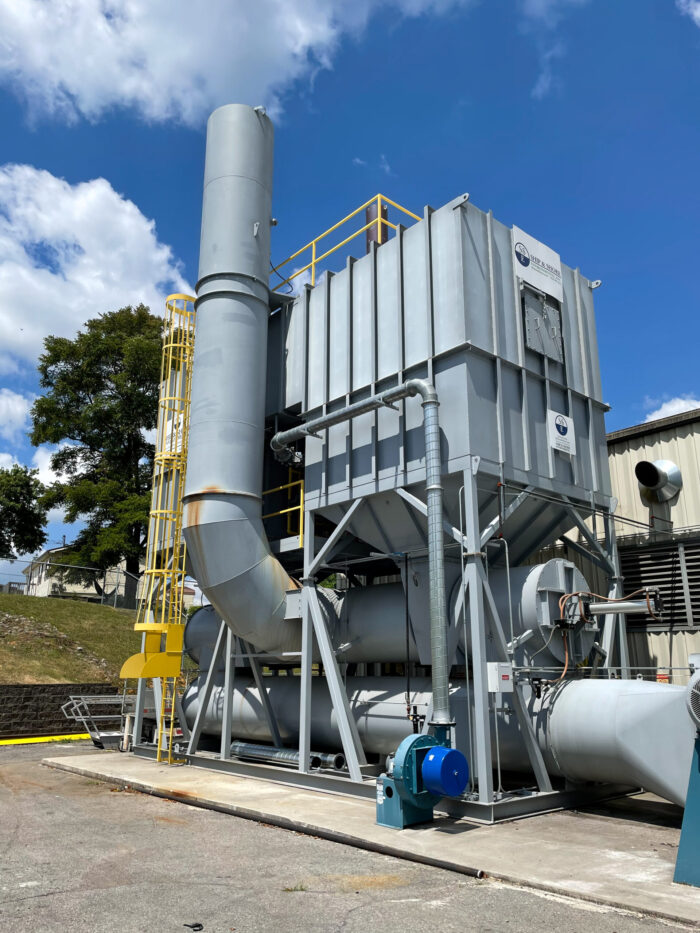

Representative Ship & Shore RTO and industrial application imagery.
Where an RTO May Fit
Common Anaheim applications to evaluate include:
- flexographic and gravure printing press exhaust
- laminating, adhesive, and package-converting lines
- industrial coating and curing ovens
- electronics or component cleaning processes
- chemical, food, and mixed-manufacturing odor or VOC sources
An RTO is not automatically the right control device for every exhaust stream. Airflow, chemistry, concentration, temperature, particulate, corrosives, production variability, permit limits, energy goals, and lifecycle cost should be compared before the control strategy is selected.
Engineering the Real Operating Case
For printing and converting operations, Ship & Shore reviews press speed, color decks, dryer airflow, ink and solvent families, cleanup events, web width, shift schedule, current capture, and expansion plans. For coating or mixed manufacturing, the analysis also considers oven zones, batch peaks, moisture, particulates, corrosives, temperature, and simultaneous source operation. These inputs affect fan control, LEL monitoring, ceramic media selection, valve cycles, heat recovery, and fuel use.
Learn how airflow in SCFM, VOC loading, and lower explosive limit affect the design basis.
Regional access without a fictional branch office
A Southern California RTO Manufacturer Near Anaheim
Ship & Shore’s headquarters and manufacturing operations are at 2474 N. Palm Drive in Signal Hill, California. That Southern California base can make Anaheim site reviews, construction meetings, operator training, and planned maintenance easier to coordinate than engagement with a remote supplier. Field availability, traffic, access windows, and response timing are set for each project, so proximity is presented as a practical advantage rather than a service-time guarantee.
Anaheim facilities often need installation work sequenced around active production and limited shutdown periods. Ship & Shore can coordinate source capture, ductwork, fan and damper controls, the RTO, stack, utility interfaces, commissioning, and training within one project plan. Where solvent concentrations vary with line speed or product mix, variable-flow strategies and heat-recovery options can be evaluated against the real operating schedule.
Explore Ship & Shore’s regenerative thermal oxidizer systems, collection-system design and fabrication, and equipment-installation services.
Project Inputs That Matter
- Minimum, normal, and maximum airflow by source
- VOC and HAP constituents, concentration, and peak mass loading
- Temperature, moisture, particulate, and corrosive compounds
- Production schedule, cleanup cycles, and future expansion
- Capture requirements, permit limits, and test conditions
- Footprint, utilities, access, and installation windows
Bring the data available now. Ship & Shore can identify gaps and help define the next engineering step.
South Coast AQMD Permitting and Compliance Context
Anaheim stationary-source projects may fall within the South Coast Air Quality Management District. South Coast AQMD’s official permits program explains that permits are used to evaluate and regulate stationary equipment, while its common operations and equipment guidance includes coating and flexographic-printing activities among operations that may require review.
Applicable rules can affect capture efficiency, VOC limits, destruction efficiency, monitoring, recordkeeping, source testing, and schedule. Ship & Shore can develop equipment and process information for the control-system scope, while the facility and its permitting professionals remain responsible for the permit strategy, agency communication, and final approvals.
Related Local and Industry Resources
From Evaluation to Lifecycle Service
Ship & Shore can support application review, system design, fabrication, collection and ductwork coordination, controls integration, installation planning, commissioning, training, and ongoing service. After startup, planned inspections, replacement-parts strategy, troubleshooting, valve and media reviews, controls work, and performance testing help facility teams maintain the system as process conditions evolve.
Company-wide experience: Ship & Shore reports more than 25 years in clean-air systems, more than 1,000 custom systems installed worldwide, and 99%+ destruction removal efficiency on most RTO applications. Project-specific performance depends on the verified process basis and final design. The company’s aftermarket team also supports many systems manufactured by other suppliers.
Anaheim RTO Questions
What information is needed to evaluate an RTO in Anaheim?
Start with airflow by source, exhaust temperature, VOC and HAP constituents, normal and peak loading, production schedule, cleanup cycles, required control efficiency, utilities, footprint, and future expansion. Existing permits, source-test data, drawings, and operating trends can make the initial review more precise.
What data should an Anaheim flexographic printer collect?
Useful inputs include airflow by press and dryer, press speed, ink and solvent chemistry, normal and peak VOC loading, cleanup cycles, shift schedule, simultaneous operation, capture conditions, future presses, utilities, and permit test requirements.
Can RTO heat be recovered for another plant use?
Potentially. Secondary heat recovery can support process air, water, or other loads when temperature, duty cycle, fouling risk, pressure requirements, and economics align. Ship & Shore evaluates the opportunity using the actual operating profile.
Talk With a Southern California RTO Engineer
Share your process data, compliance objective, and project schedule. Ship & Shore can help define the next engineering step.
Prefer a quick written answer? Open the live chat widget in the lower-right corner.