CASE STUDY – Boilers and RTO Integration for Reliable EPS Production and VOC Control
March 4, 2026 10:05 am
CASE STUDY – Boilers and RTO Integration for Reliable EPS Production and VOC Control
March 4, 2026
Industry: Expanded Polystyrene (EPS) Manufacturing
Location: Midwest, United States
Application: Steam Generation and VOC Emissions Control
The Challenge
At this EPS facility, operators experienced unstable steam supply and inconsistent VOC oxidation during production peaks. Boilers could reach VOC destruction temperatures >1,450°F only at full load. During low-load or startup, furnace temperatures fell, causing pentane vapors to accumulate, triggering pressure fluctuations, actuator stress, and intermittent poppet valve cycling.
These conditions led to production delays, compliance risks, and unplanned maintenance, threatening both operational efficiency and adherence to EPA VOC standards.
Why the Boiler Matters
Boilers are the backbone of EPS production, converting fuel energy into steam for bead expansion, molding, and heating processes.
- Firetube Boilers: Hot gases pass through tubes surrounded by water, generating steam at moderate pressure, ideal for small-to-mid EPS operations.
- Water tube Boilers: Water flows inside externally heated tubes, producing higher-pressure steam quickly for large-scale operations.
While boilers can reach VOC destruction temperatures, variable loads and furnace volume make continuous oxidation unreliable. Using boilers alone for abatement risks compliance and efficiency.
Ship & Shore Environmental Solution
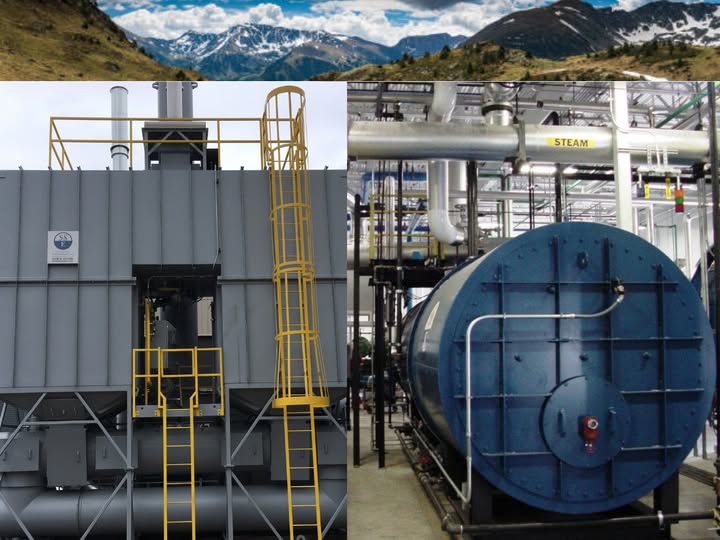
A Regenerative Thermal Oxidizer (RTO) was integrated with the existing boiler system to ensure consistent VOC destruction while maintaining stable steam supply:
- Independent VOC treatment: 98–99% destruction efficiency regardless of steam load.
- Optimized combustion: Operates at 1,500–1,800°F with sufficient residence time.
- Heat recovery: Ceramic media recovers up to 97% of thermal energy.
- Source capture engineering: Custom hoods collect pentane vapors at origin.
- Maintenance plan: Six-month inspection cycle to sustain performance and compliance.
Results
- Stable steam supply for reliable EPS expansion
- Predictable VOC destruction at 98–99% efficiency
- Reduced downtime and maintenance costs
- Energy savings through recovered heat
- Compliance with EPA VOC regulations
Conclusion
Boilers are essential for EPS operations but cannot reliably achieve VOC abatement alone. Pairing boilers with engineered RTOs ensures safe, compliant, and efficient production, protecting both capital and regulatory standing. Ship & Shore Environmental delivers solutions that balance energy use, emission control, and operational reliability.
📞 Contact us at +1 (562) 997-0233
📧 Email: service@shipandshore.com
Categorised in: Case Study & White Papers, News, News, VOC Abatement